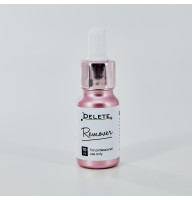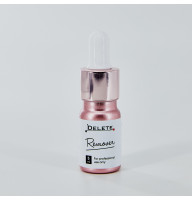
Masters of permanent makeup often face a request to remove the tattoo - unsuccessful, became dumb or just bored. But it is not enough to satisfy the client’s needs. You need to be able to identify the problem correctly, assess the features of the skin and the tattoo itself, choose the most effective and safe methods and means, and use them correctly.
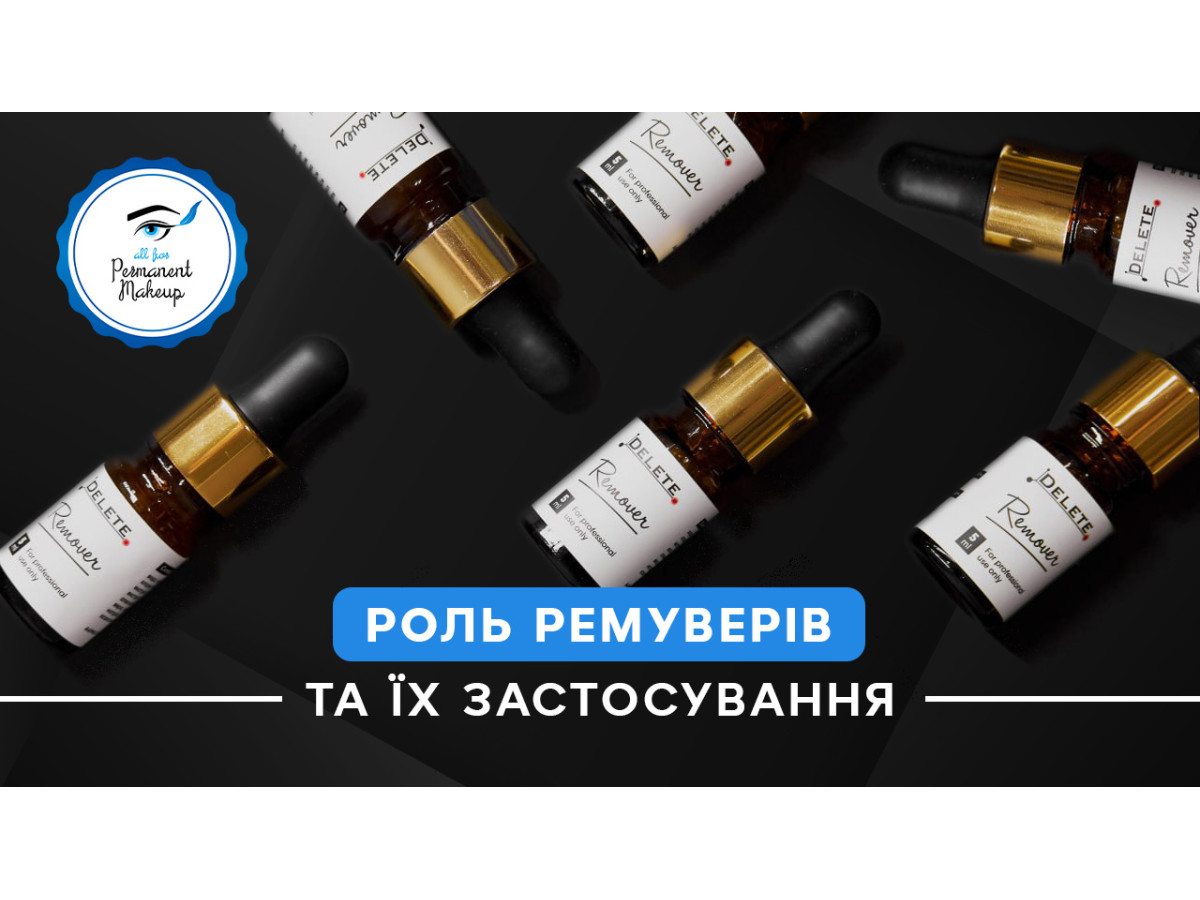
Removers - suspension for tattoo removal - can be called a perfect tool. They are suitable for most cases, effectively deal with the removal of pigments and, if properly applied, are safe from the point of view of possible complications. In this article we will introduce you to different types of removers, specifics of their action and peculiarities of application.
Tattoo Remover: Essential Ingredients
The action of the remover is determined by its composition, and on this depends on the choice of a tool when removing the tattoo in different situations.
Active components and their role in the disposal process
Each remover has its own patented composition, which can include not only active components (acting directly on the pigment), but also auxiliary - contributing to faster skin recovery, removal of residual dye particles, etc.
Acid
The active substances of such removers are represented by organic or inorganic acids. It can be hydrochloric, glycol, hydroxyantaric, wine, salicylic or other acid in a concentration that provides safe application on the skin.
The depigmating effect of acid removers is caused by the breakdown of the bonds in the paint molecules, so that it loses its stability and is eliminated from the skin. Depending on the amount of acids included in the product, it can be one-, two- or multi-component.
Alkali
The effect of alkaline remover is based on hydroxides (therefore they are also often called oxide). It could be potassium hydroxide, calcium, sodium, etc.
Such means are more «rigid» than acidic, as their effect is due to the hydrolyzation of cells. In fact, alkali, entering the skin, dissolves the cell membrane, which leads to the release of enzymes - it is they who are given the main role in the destruction of pigment.
Salt
The active substance of such removers is salt, most often marine. Tattoo removal uses the natural property of all salts to absorb water. When it enters the skin, the concentrated salt solution «absorbs» into itself both liquid and pigments present in it. To achieve the effect requires a sufficiently high concentration of the solution, which is not always safe for the skin. Although salt formulations are effective against pigments, the recovery period is longer than with other tattoo removal methods.
Combined
Such tools are most popular with professional tattoo artists. The active substances are carefully selected heterogeneous substances. Most often it’s acids and salts. In acid-hydrochloric removers, acids act as pigment disruptors, and salts accelerate the removal of dye decay products from the skin. In this case, the salt component is characterized by a lower concentration than in monosalt products, so the risks of skin injuries are minimized.
Thanks to this composition, the high efficiency of the remover is maintained, and its safety is increased - including by the fact that it is not necessary to repeatedly use the drug on the same skin area.
How to choose a suitable remaver: expert advice
Alkaline formulations are recommended when removing a surface-treated pigment. At deeper - acidic, and acid-hydrochloric.
As for the color of the pigment, the technique of the tattoo and the area (except the interciliary) - the composition of the product does not play a role, since any type of remover will be effective.
For coarse skin, acid compounds are better, and for the treatment of surface tattoo on thin - alkaline. Universal can be called acid-salt - they are effective and safe on almost any type of skin.
At the consultation stage, it is necessary to obtain information from the client regarding the propensity for allergic reactions, the formation of keloid scars, and the presence of diseases/conditions that are indicated as contraindications to the chosen tool.
It is also necessary to visually assess the condition of the skin in the tattoo area to get an idea of how it reacted to the procedure. So, on a fresh permanent make-up on the possible risks indicates too long an inflammatory reaction, and on the old - microscars, skin roughening. In such cases, it is recommended to carry out a test removal on a small area and evaluate the skin reaction to the selected remover.
Steps for applying a remaver for tattoo
Cosmetology has developed a clear sequence of actions that increase the effectiveness of the remivers and reduce the likelihood of side effects or complications.
Procedure preparation
The first stage of preparation is entirely on the customer’s responsibility. It is recommended that he should not take any anticoagulants and antiaggregates 5-7 days before the procedure. And when you remove the tattoo on the lips in 3-5 days, you should start taking an antiherpetic drug.
Immediately before the procedure, the master processes the desired area with an antiseptic, after which he applies an anesthetic to it. After 5-20 minutes, the residue of the analgesic gel is removed, and the actual administration of the remover begins.
Remover application and massage for better impact
The remwer is injected with a conventional tattoo machine, but instead of pigments, the chosen agent is used. Needles must enter the skin at an angle of 90 ํ - this provides maximum "damage" for pigments, and facilitates the pushing of their residues to the skin surface.
After the first or second pass the master can use massage techniques to make the remover better distributed in the skin. It is recommended to use light strokes, but in no case do not press and rub.
Post-procedural measures and skin care
At the end of the session, the skin is additionally treated with antiseptic. As a finishing touch, you can apply the remaver to the treated area - passively penetrating the microbanks, it will continue its action.
It is important to use alcohol-free antiseptics, as it, having a tannin action, «closes» pores and microscopes, not allowing the remover to penetrate inside the skin. Further care remains the responsibility of the client. It should be informed that to restore the skin and avoid unwanted effects it is important:
- Eliminate skin contact with water during the first 1-3 days (depending on the means used);
- for 5-10 days to abandon any thermal procedures (sauna, steam bath, etc.);
- avoid contact with the skin of UV rays - this applies both to staying under the sun and to visiting solariums;
- for 3-5 days, exclude any chemical and mechanical impact on the treated areas (cosmetic massage, peeling, scrubs, masks, decorative cosmetics, etc.).
If possible, the client should refuse physical activity and stay in the heat (summer). And if this is not possible, it is recommended to wear a absorbent bandage on the forehead, which will prevent sweat from hitting the treated areas.
In all cases, when one procedure of tattoo removal was not enough, it is recommended to repeat after complete skin recovery. This allows the master to accurately assess all the subtleties of the situation, the reaction of the skin, the quality of the destruction of pigments by the chosen method and, if necessary, adjust the technique at a subsequent session.
With the implementation of these rules and strict compliance with the manufacturer’s recommendations, the remover will help get rid of the tattoo without problems - both during the procedure and in the recovery period.