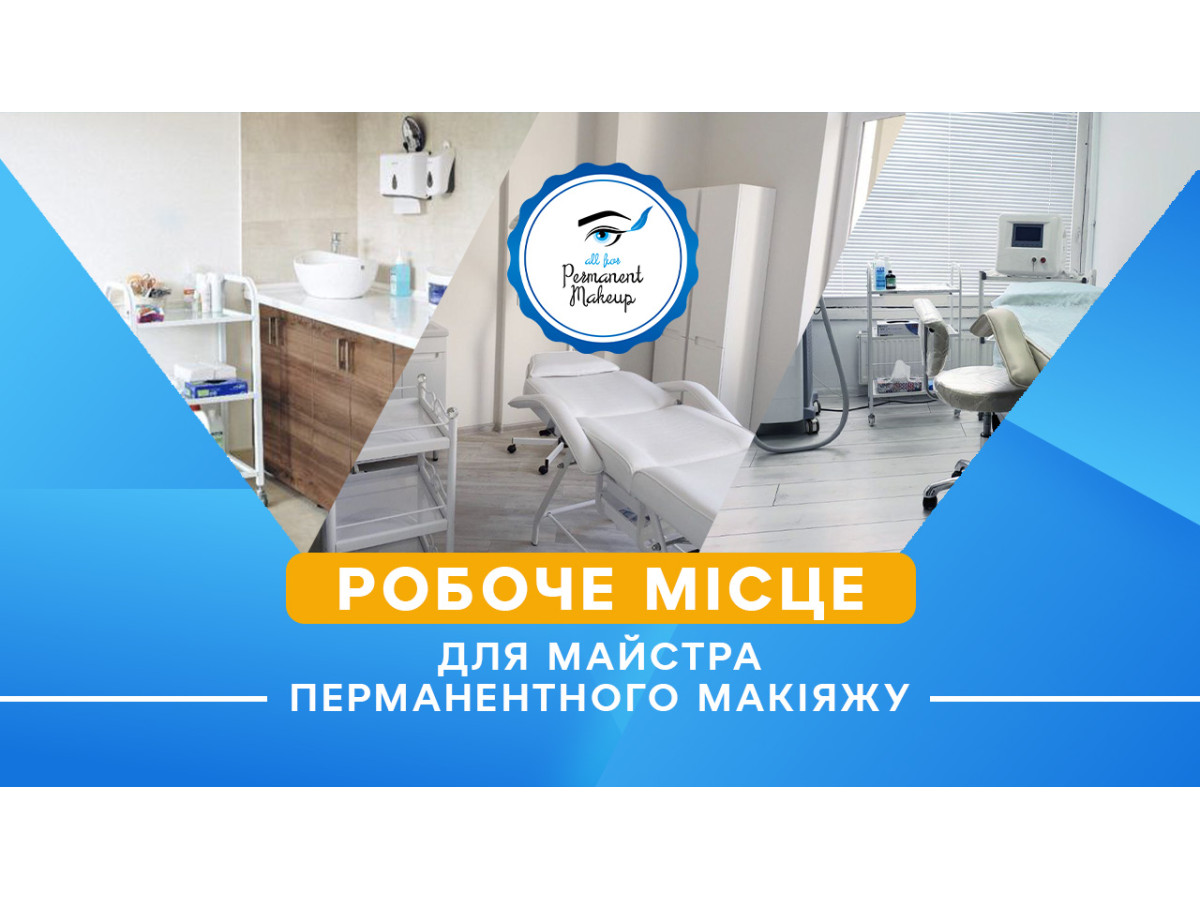
Many novice masters are wondering about the arrangement of the workplace: as if not to buy anything superfluous, but in the same line have everything you need at hand, adhering to all the norms.
Consider the main points of interest:
1. Equipping the office
The requirements for the premises to perform permanent makeup are due to double standards - this is manipulative, where the damage to the integrity of the skin, and the act of creativity of the master.
The area of the workplace of a specialist should be 12-15 square meters. m.
The office should be connected to the water supply and sewage networks. A place is provided for placing sterilizers.
The main furniture is a couch for a client, a master of a master, a chair for a visitor. Of course, a well -lit mirror is required so that the client can evaluate the result. A desktop, a lamp for work and a cabinet for storing equipment and materials are also needed.
There are quite harsh requirements to the premises for permanent makeup, but all of them can be reduced to one thing: it is necessary to observe cleanliness!
All external and internal surfaces in the office should be detergent, it is necessary to carry out wet cleaning twice a day (processing of floors, furniture, equipment, window sills, doors) using disinfectants, and once a week - general cleaning. The walls can be painted with light washing paint or finished with tiles, the floor is tiled or covered with linoleum. It is necessary to have an ultraviolet lamp for disinfection of the room. The desktop should be processed with an antiseptic after each client.
There should be natural lighting in the office. But since the lighting should be bright enough for work, you can use a cosmetic bosmatic lamp, a light lamp or - in a more expensive version - a surgical bosot lamp. Also in the office, it is necessary to provide for the common (upper) light sources and, as already mentioned, “make -up” lighting at the mirrors.
Simple incandescent lamps are not suitable for permanent makeup - because, in particular, they distort the colors in the direction of the yellow tone; To prevent this from happening, daylight lamps are used.
There should be no plants in the office as they are an excellent environment for the propagation of bacteria.
Ventilation is also necessary to ventilate the office.
2. Sterism
To ensure the sterility of the tools used, the appropriate equipment is necessary:
- Glass perlane sterilizer.
- Ultraviolet sterilizer in which processed tools are stored.
- A bath for soaking used tools (tubes, needles, etc.). It is soaked in both reusable (before sterilization) and disposable (before recycling) equipment.
- Autoclaves and dried cabinets, craft packages-they can not be located in the office itself, but in the next room.
It is forbidden to use the cabinet of permanent makeup for relaxation, changing staff, eating and other extraneous purposes.
The master is obliged to work in replaceable clothes (robe) and replaceable shoes.
3. Consumables for the procedure:
- sterile apparatus for permanent makeup;
- sterile needles, needle modules, nozzles (depending on the device);
- capsule (container for pigment);
- stand for capsules and apparatus;
- chemical disinfectant solution for specialist hands; special composition for processing instruments (lisetol, lysoformin in low concentration);
- anesthetic;
- pigment for the procedure;
- pigment thinner;
- toothpicks or spatula for mixing pigment;
- tweezers;
- pencil for sketching, a set of shadows for preliminary drawing;
- post-procedure care cream;
- glass; makeup remover;
- wipes (wet and dry);
- mirror;
- waste bin;
- disposable caps (for the master and the client);
- latex gloves;
- mask;
- shoe covers (client wears at any time of the year);
- a variety of non-woven products are used to cover the couch (disposable sheet);
- cotton pads;
- cotton swabs (must be treated with a UV lamp);
- paper towels;
- first aid kit.
4. Order on the work table.
The table is covered with a treated medical napkin (changed after each client), a sterile disposable napkin is placed on top - everything that is needed for a particular client and that will be thrown away after the procedure is laid out on it.
All work surfaces that are touched by a gloved hand stained with blood (lamp, bottles of creams, a jar of antiseptic, a machine, etc.) are protected with cling film. It is also convenient to use small (packaging) plastic bags.
The top shelf of the table should only contain what is used during the procedure; everything else should be placed on the bottom shelf.
Client comfort can be ensured in different ways: a cozy blanket, a music system with headphones, a TV. Little things like makeup remover and eye drops will also help him feel cared for. And a cooler with drinking water will allow you to treat him with a cup of tea after the procedure (remember that tea drinking should not take place in the office, but in the rest room).
Don’t forget, if a client feels loved and protected during your procedure, he will come back to you again and bring a friend!!!