
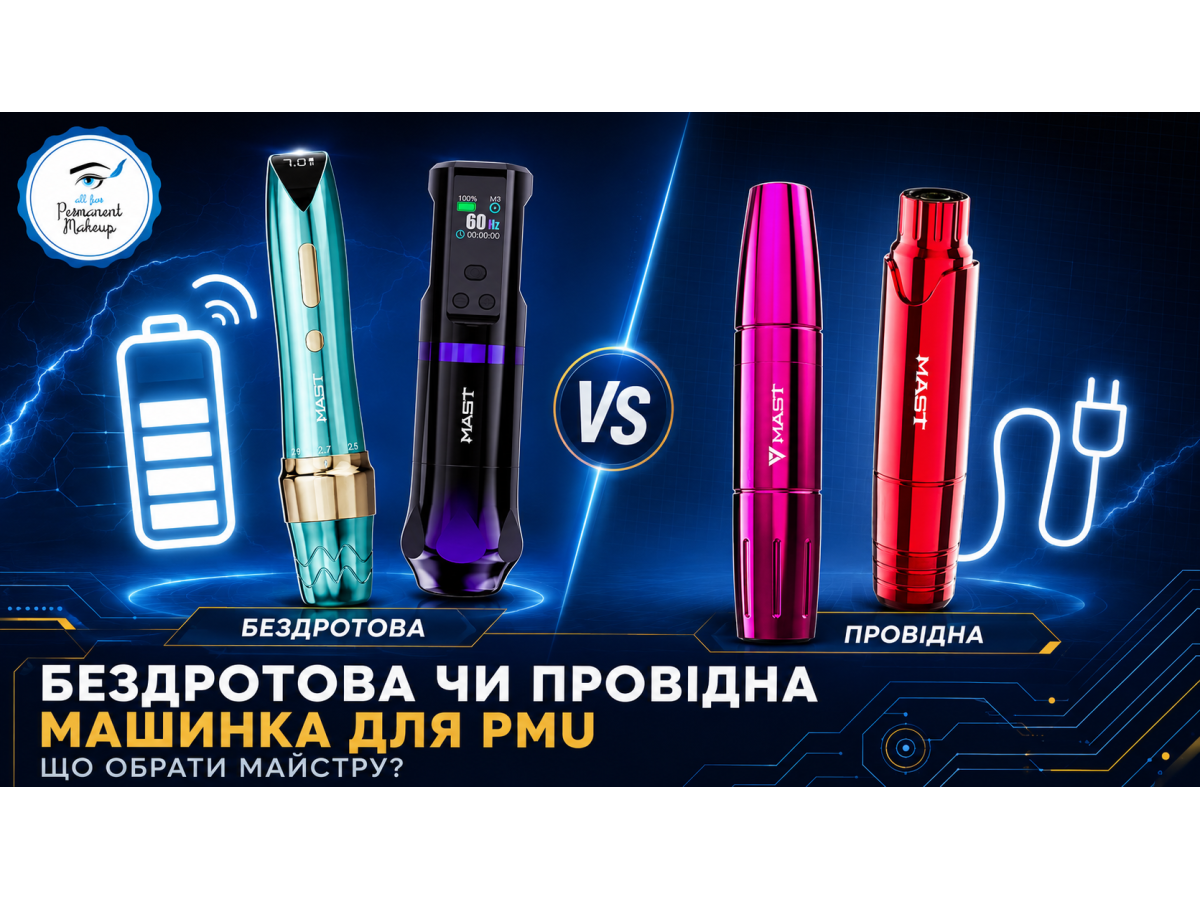
But when an artist starts choosing equipment, a logical question appears: which is better — a wireless or wired PMU machine?
There is no single answer. Both options can be professional, convenient, and effective. The difference is not that one type is “good” and the other is “bad.” The difference is in the tasks, working style, artist’s habits, procedure duration, machine weight, power stability, and mobility needs.
In this article, we will look at the advantages and disadvantages of wireless and wired permanent makeup machines, compare them for brows, lips, and eyelids, and explain what to pay attention to before buying.
What is a wired PMU machine?
A wired machine works from a power supply through a cable. The artist connects the device to the mains or a professional power supply, sets the required voltage or mode, and works with constant power throughout the procedure.
This format was the standard in the PMU and tattoo industry for a long time. Wired machines are valued for stability, control, and predictable performance. If the power supply is high quality and the cable is in good condition, the machine works evenly and does not depend on battery charge.
For many artists, a wired machine remains the most convenient option for salon work. It is suitable for longer procedures: lips, cover-ups, corrections, dense shading, complex brows, or combined techniques.
What is a wireless PMU machine?
A wireless machine works from a battery. It has no cable, so the artist gets more freedom of movement. This format has become especially popular among artists who like a minimalist workstation, work on location, teach, or do not want to depend on a cable during the procedure.
Wireless machines may have a built-in battery or replaceable battery modules. Some models allow voltage adjustment directly on the body, while others have several preset modes.
The main advantage is mobility and the absence of a cable that can interfere with the hand, catch on the table, or require additional barrier protection.
However, the wireless format has its own nuances: charge level, battery weight, working time, power stability, hand balance, and the need to have a spare battery.
Work stability
One of the main criteria is stroke stability. In PMU, it is important that the needle works evenly, without jerks, power drops, or unpredictable changes in performance. This is especially noticeable on thin skin, eyelids, lips, and during delicate pixel shading.
A wired machine usually provides stable power if a good power supply and high-quality cable are used. It does not “run down” during the process, does not lose power because of battery discharge, and allows long work without charging pauses.
A wireless machine depends on the battery. In high-quality models, this is almost unnoticeable: the device holds power evenly until the end of the charge. But cheaper or worn-out batteries may have power drops, especially closer to discharge.
For the artist, this may appear as less stable pigment delivery or a need to adjust hand speed.
The conclusion is simple: if absolute stability during long procedures is critical for you, a wired machine may be a more reliable choice. If you choose a wireless machine, it is important to buy a quality model and have a spare battery.
Freedom of movement
The main advantage of a wireless machine is freedom. There is no cable stretching to the power supply, interfering with hand position, or requiring constant control. It is easier for the artist to move around the client, change the angle, work from different sides, and not think about where to place the cable.
This is especially convenient when working on brows, where the artist often changes hand position, tilt, and direction of movement. The wireless format is also preferred by those who work in small rooms, conduct workshops, or perform mobile procedures.
A wired machine is less mobile, but this is not always a disadvantage. Experienced artists get used to the cable and organize the workstation so it does not interfere. The cable can be covered with a barrier sleeve, the power supply can be placed correctly, and the cable can be fixed so it does not pull the hand.
If you value maximum freedom of movement, a wireless machine will be more convenient. If you work in a fixed location and the cable does not bother you, a wired option can be comfortable and stable.
Weight and hand balance
Wireless machines are often heavier because of the battery. Even if the difference seems small, it can be felt during a 2–3 hour procedure. Hand fatigue, finger tension, wrist discomfort — all of this affects the quality of movement.
Wired machines are usually lighter because they do not have a battery block on the body. They may be more convenient for artists with smaller hands, for long procedures, or for those who work delicately and do not like heavy devices.
But weight is not the only factor. Balance matters. Some wireless machines are designed so the battery does not outweigh the body, and the device sits comfortably in the hand. Some light wired models may be uncomfortable because of their shape, diameter, or vibration.
Before buying, it is best to hold the machine in your hand. If possible, test it on artificial skin. Technical specifications are important, but the artist’s hand often gives the most honest answer.
Barrier protection and hygiene
In PMU, any machine must be protected with a barrier. A wired model requires protection not only for the body, but also for the cable. Barrier sleeves, film, machine bags, and proper cable placement in the working area are used for this.
A wireless machine is easier to cover with a barrier because there is no cable. This simplifies workstation preparation and reduces the number of elements the artist touches during the procedure. However, the battery, control buttons, and display also need protection if they are in the contact zone.
Important: a wireless machine does not mean “less disinfection.” After the client, the barrier is removed, surfaces are checked, and the device is processed according to the manufacturer’s instructions. If the battery is removable, the artist must understand how to protect it correctly without damaging the contacts.
From the point of view of cleanliness organization, a wireless machine is often more convenient, but only if the artist does not neglect barriers and processing protocol.
Working on brows
Both types of machines are suitable for brows. If the artist works in a powder brow technique, stroke stability, soft pigment delivery, speed control, and hand comfort are important.
A wireless machine can be very convenient for brows because of freedom of movement. The artist can easily change position, work on the right and left brow, avoid thinking about the cable, and adapt the angle faster.
A wired machine works well for stable salon work. If the artist is used to the cable, it does not interfere. On the contrary, a lighter body can be an advantage during long shading or work on difficult skin.
For brows, what matters most is not whether the machine is wireless or wired, but how stable it is, whether it avoids unnecessary skin trauma, whether it is compatible with the needed cartridges, and whether it gives the artist control.
Working on lips
Lips often require a longer procedure than brows. Stability, even implantation, and artist comfort over a long time are important here. If the procedure lasts long, a wireless machine must last the full session without power drop.
A wired machine has an advantage in this case: it does not depend on charge. The artist can work calmly without thinking about the battery. This is convenient for dense filling, correction of cool lips, or complex asymmetry.
A wireless machine can also be an excellent option for lips if the battery is high quality and there is a spare block. But if the device is heavy, the hand may get tired faster, especially during even filling of a large area.
For lips, the machine should be chosen not by trend, but by stability, weight, and ability to work long without losing quality.
Working on eyelids
The eyelids are the most delicate area, where maximum precision is important. There should be no excessive vibration, unstable stroke, or uncomfortable balance. The artist must control every movement.
A wireless machine can be convenient because there is no cable pulling the hand. But the device should not be too heavy. If the machine is unbalanced, it may interfere with precision.
A wired machine is often lighter, which is an advantage for fine work. But the cable must be positioned so it does not create tension or affect hand movement.
For eyelids, the main priorities are lightness, stability, minimal vibration, and artist confidence. The power type is secondary here.
What is better for a beginner?
A beginner should not chase trends. Wireless machines look modern, convenient, and attractive, but that does not mean they are automatically better for learning. Wired machines often provide more stability and help the artist focus on technique rather than battery charge.
A good starting option is a quality universal machine that suits the main areas, has a stable stroke, is not too heavy, is compatible with popular cartridges, and feels comfortable in your hand.
If a beginner practices a lot, spends long training sessions on artificial skin, or is still developing hand control, a wired option may be practical. If the artist immediately works in a mobile format, teaches, or does not want cables on the table, a wireless machine may be more comfortable.
What is better for an experienced artist?
Experienced artists often have not one machine, but several. One may be the main machine for lips, another for brows, and a third for eyelids or mobile work. This is normal practice because different tasks require a different feel from the device.
A wired machine may remain the main option for long procedures and stable salon work. A wireless machine may be convenient for quick procedures, demonstrations, training, mobile work, or situations where freedom of movement matters.
For an experienced artist, the main thing is not the format, but control. If the device gives predictable results, works well with favorite cartridges, and does not tire the hand, it is suitable.
Common mistakes when choosing a machine
The first mistake is buying a machine only because it is popular on social media. What is convenient for one artist may be uncomfortable for another.
The second is choosing a wireless model without a spare battery. If the battery runs out during the procedure, it creates stress for both the artist and the client.
The third is ignoring weight. Even a powerful and beautiful machine may be uncomfortable if the hand gets tired quickly.
The fourth is saving on cable or power supply quality for a wired machine. Unstable power affects device performance.
The fifth is not thinking about barrier protection. A machine should be not only convenient, but also suitable for safe work.
The sixth is buying an overly complicated device at the start. Beginners need clear settings, stability, and comfort, not the maximum number of modes.
Checklist before buying
Before choosing a machine, ask yourself several questions:
- which areas I will use it for: brows, lips, eyelids;
- how long my procedures last on average;
- whether freedom of movement without a cable is important to me;
- whether I am ready to monitor battery charge;
- whether there is a spare battery or fast charging option;
- whether the machine may be too heavy;
- whether it feels comfortable in my hand;
- whether it is compatible with the cartridges I use;
- whether it is easy to cover with a barrier;
- whether there is service support, warranty, and clear instructions.
If most answers are clear, the choice will be much easier.
Conclusion
Wireless or wired PMU machine is not a question of “what is better in general,” but “what is better for your work.” A wireless machine gives freedom of movement, fewer cables on the table, and convenience in a mobile format. A wired machine gives stable power, lower hand weight, and confidence during long procedures.
For brows, wireless freedom is often convenient. For lips, long-term stability matters. For eyelids, lightness, precision, and minimal vibration are key. For a beginner, the most important things are not trends, but control, comfort, and safety.
A professional artist chooses not just a beautiful machine, but a tool that helps work cleanly, evenly, and predictably. Sometimes it will be a wireless device. Sometimes it will be a wired one. And sometimes the best solution is to have both options for different tasks.