
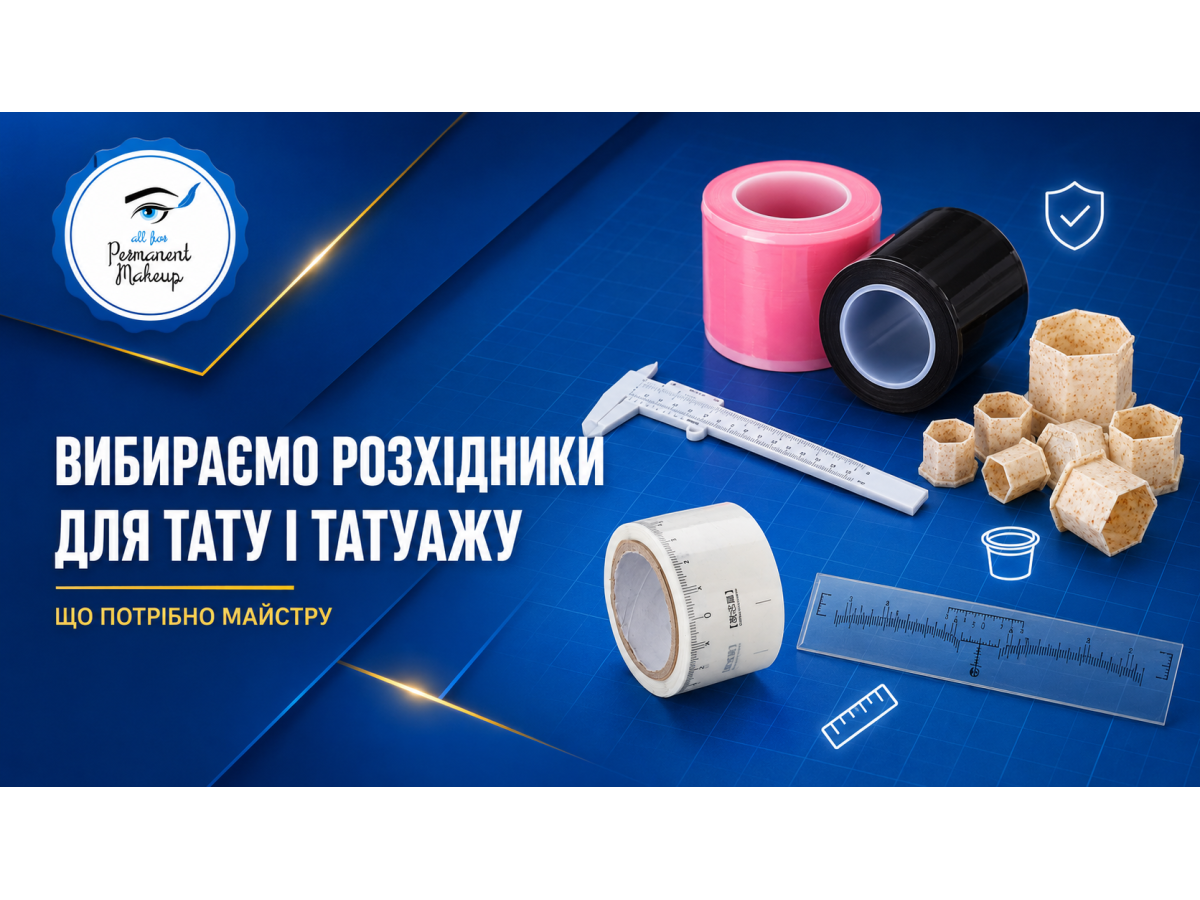
Even beginners in the tattoo and permanent makeup industry understand the importance of choosing a high-quality tattoo machine, power supply, and other essential tools and equipment. Things become less straightforward, however, when it comes to consumables. What are they, why are they needed, and how should they be selected?
What are tattoo and permanent makeup consumables?
In general terms, consumables are any materials, tools, or products used during a work process that are not intended for reuse. In tattooing and permanent makeup, this category includes:
- needles and cartridges
- pigments
- disposable pigment caps
- tips
- barrier protection products, including disposable gloves, masks, sheets, sleeves and protective film for equipment, cohesive bandages, and more
- tattoo aftercare film
- and many other materials and products, ranging from thinners and removers to disinfectants and antiseptics
Even this incomplete list makes one thing clear: consumables account for a substantial share of everything used during tattoo and permanent makeup procedures. Their main categories deserve particular attention and should be selected with the utmost care.
Main categories of consumables
Needles, cartridges, and pigments are essential items in every tattoo artist’s and permanent makeup artist’s kit. More than all other consumables combined, they affect the precision, quality, and safety of pigment implantation. As a result, they directly influence the artist’s professional reputation and the client’s satisfaction with the outcome.
Needles and cartridges
Although needles and cartridges perform the same function—delivering pigment into the skin—several design characteristics should be considered when selecting them.
Needle types and their uses
Tattoo and permanent makeup needles vary by configuration, the number of needles in the grouping, and their intended application. The main types include:
Singl. Needle. Used to create fine, crisp lines, such as eyebrow and lip outlines or eyeliner. These needles provide high precision and allow the artist to work on small details.
Roun. Liner (RL). Used to create outlines and lines of different thicknesses. A grouping may contain 3 to 9 needles or more. Depending on the number of needles, an RL configuration can produce either very fine or thicker lines.
Roun. Shader (RS). Designed for shading, colour filling, and creating smooth transitions and gradients. These configurations make it possible to achieve soft, even colour transitions.
Fla. (F). Used to create wide, even lines and fill larger areas of skin with pigment. Flat configurations can significantly reduce procedure time by covering larger areas quickly and distributing pigment evenly.
Magnu. (M1 and M2). Used for shading and creating smooth colour transitions across larger areas of skin. M1 needles are arranged in two rows directly above one another, while M2 needles are arranged in a staggered pattern. They provide soft and even pigment implantation, enable efficient coverage of large areas, and help create smooth gradients.
When choosing needles, it is also important to consider their diameter, taper length, whether the needle tip is textured or polished, needle protrusion, and other technical parameters.
Benefits of using cartridges
Cartridges offer many of the same options in terms of needle grouping, diameter, taper, and texture as traditional needles. However, there are several significant differences between these two types of consumables. These differences account for the benefits of cartridges and explain why they have become especially popular among tattoo and permanent makeup artists.
A cartridge is a separate modular system in which a needle grouping is housed inside an individual casing, with the needles protruding through an integrated tip.
The chamber containing the needles is made from transparent, high-strength polymer. Depending on the system, it may include a membrane designed to protect the machine from pigment, biological fluids, and small particles entering the drive mechanism.
These technical features give cartridges several important advantages:
- reduced lateral needle movement and, consequently, greater procedural precision
- less pigment splatter and more economical pigment use
- protection of the machine against premature wear caused by liquids entering its internal mechanism
- quick switching from one module to another during a procedure, without the need to manually fit or adjust individual needles
Another important advantage is versatility. Although cartridges are primarily compatible with rotary pen-style machines, leading manufacturers such as Kwadron, Mast, and others produce modules that work with both their own machines and many devices made by other brands.
Pigments
Tattoo and permanent makeup pigments can also be a challenging subject for beginners. Experienced professionals have usually developed their own ranking of preferred brands and formulas, whereas newcomers may find it difficult to navigate the enormous selection available today.
Types of pigments and their characteristics
Permanent makeup pigments are divided into three main categories according to their composition:
Organic. These colourants are synthesised under laboratory conditions, allowing manufacturers to control their composition and safety more precisely. Their pigment particles are very small, so organic pigments are generally implanted into the skin more easily. They produce bright, intense colour that usually becomes less saturated over time and may, in some cases, shift towards a cooler tone. Organic pigments should be implanted without excessive pressure or overly dense passes: the finely dispersed particles, combined with a water-alcohol base, enter the skin easily and provide strong coverage.
Inorganic. These are mineral pigments containing iron oxides and other mineral compounds. They generally produce warmer, softer results that closely resemble natural shades. Because their particles are larger and heavier, inorganic pigments may be more difficult to implant and require calm, controlled work with consistent passes. They often benefit from a compatible thinner that makes the formula lighter and easier to work with.
Hybrid. These pigments contain both organic and inorganic components, giving them a wide range of shades and applications. Their palettes include numerous combinations and tones designed to retain the desired characteristics in the skin, while their lighter texture allows artists to work in many techniques, including powder shading.
Regardless of the pigment type you use, you may also need its complementary products—removers and thinners. These products should be selected according to the composition of the pigments used for tattooing or permanent makeup.
How to choose a high-quality pigment
Understanding pigment compositions and categories is relatively straightforward. Choosing a genuinely high-quality product from the vast number of available options is much more difficult.
The same basic principle applies as when purchasing many other products, from clothing to cars: one of the main factors to consider is the brand. Established manufacturers whose products are in strong demand in the beauty industry take great care of their reputation and do not knowingly release untested formulas or questionable products. Examples include Aqua, LIK, The Mineral, StarInk, D|N, and similar professional brands.
Every reliable manufacturer provides its own pigment classification system, for example by treatment area (brows, lips, or eyelids) and colour temperature (cool or warm). Detailed guidance on dilution, mixing, and colour correction is usually available as well. Pigments supported by clear professional instructions are easier to work with and are less likely to disappoint either the artist or the client.
Other consumables
In addition to needles, cartridges, and pigments, an artist’s workstation should include other consumables without which safe and comfortable work is simply impossible. These include:
Hygien. and protective products. These include gloves, masks, gowns or aprons, disposable sleeves, barrier protection for the tattoo machine and clip cord, disposable spray-bottle covers, cohesive grip bandages, and other protective items. Such consumables protect not only against contact and airborne infections but also against pigment splashes.
Consumabl. liquids. These include pigment thinners, solutions for rinsing tips and other components, antiseptics, and disinfectants.
Pigmen. caps. Disposable caps must be discarded after use. Reusable pigment cups are also available, but their maintenance requires time and effort as well as proper cleaning, disinfection, and sterilisation where applicable, which also creates additional costs.
Practic. skins. These products are classified as consumables only in a broad sense, because they do not always require frequent replacement. Nevertheless, they are invaluable when mixing colours, adjusting a machine for a particular technique, or testing a new pigment. They are also essential for developing new skills. Three-dimensional practice skins and tattoo or permanent makeup mannequins can be especially useful because they reproduce volume and surface contours, creating a more realistic simulation of working on actual skin.
These are the most important consumables that virtually every tattoo or permanent makeup artist will need.
Less obvious but still valuable items include pigment-cap holders, spray bottles, tattoo aftercare film, and holders for rolled products such as barrier film and cohesive bandages. Not all of them are strictly essential, but they can make the working process significantly more comfortable and contribute to better results.
Current trends in choosing additional consumables
Fortunately, the days when the lowest price was the only selection criterion are fading. Today’s tattoo and permanent makeup artists understand the value of their professional reputation and base their choices primarily on the following factors.
Safety
Safety depends to a large extent on the manufacturer—its reliability, quality control, and product compliance. The artist’s correct use of the product is equally important. Well-established brands have an advantage here as well because they provide detailed instructions for using cartridges, needles, pigments, and other supplies. Many manufacturers conduct workshops and product presentations for new ranges and provide access to professional consultants. This support may cover everything from correctly installing and using a cartridge to proper disposal and disinfection procedures.
Material quality
The quality of the materials has a direct effect on the outcome. A low-quality pigment with a questionable composition may result in poor coverage, significant pigment loss after healing, the need for repeated passes, or an unwanted shift of the selected tone towards blue or red. It can also pose health risks to the client, including allergic reactions and difficult or prolonged healing.
Tattoo cartridges made from low-quality materials may release microscopic plastic particles, potentially interfering with the healing of the treated skin.
The importance of choosing high-quality consumables cannot be overstated. They affect virtually every aspect of the procedure: the safety of both the artist and the client, proper healing after tattooing or permanent makeup, and the client’s satisfaction with the final result.