
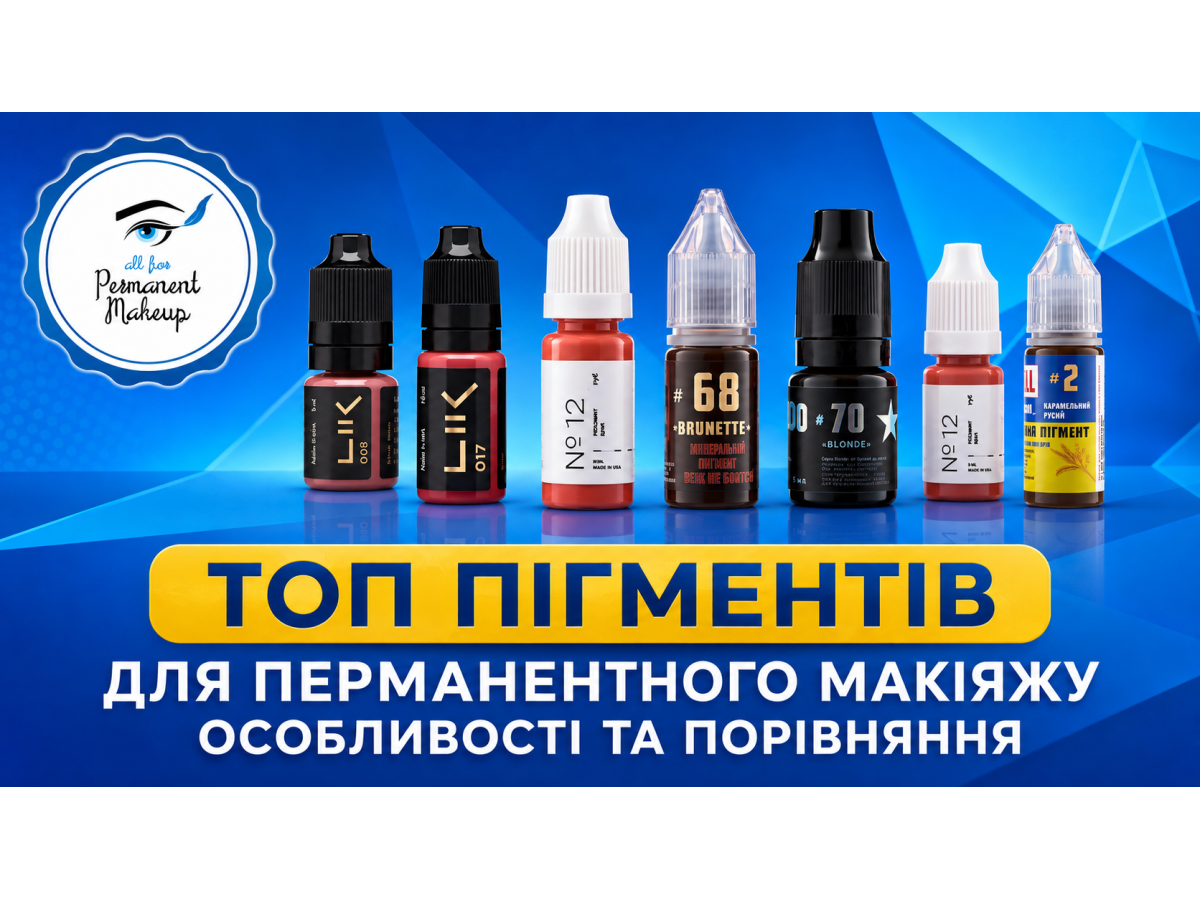
The PMU market offers dozens of brands: mineral, organic, hybrid, concentrated, soft, dense, for brows, lips, eyelids, correction, and cover-ups. That is why the idea of “top pigments” should not be understood as one universal ranking, but as a selection of brands that artists often choose for different tasks.
In this overview, we will compare popular permanent makeup pigments: LIK, The Mineral, Molecula, Prestige, Starink, and Next Level. We will look at their features, which areas they may be convenient for, and how an artist can choose a line that suits their technique.
Why there is no single best pigment for everyone
There is no universal pigment that will be equally perfect for every client. One artist works in a soft natural technique, while another prefers denser color implantation. One client has thin dry skin, another has oily and dense skin. Some lips need a nude effect, while others require correction of a cool undertone. For brows, one client may need a soft taupe shade, while another may need a rich neutral brown.
That is why a good pigment is not just a beautiful color in the bottle. It is predictability after healing, convenient consistency, a clear palette, documentation, expiration date, compatibility with technique, and safety.
It is especially important to consider the requirements of the market where the artist works. If pigments are purchased for use in countries with strict rules on composition and labeling, documents, product origin, and compliance with local requirements should be checked.
Which criteria to use when comparing pigments
Before choosing a brand, an artist should evaluate more than just the shades. It is important to look wider:
- pigment type: mineral, organic, or hybrid;
- intended use: brows, lips, eyelids, correction;
- concentration and density;
- behavior after healing;
- fading speed from the skin;
- ease of mixing;
- availability of thinner or correctors;
- documents and labeling;
- expiration date and storage conditions;
- real healed results.
If a brand is popular on social media, it does not mean it will suit your style. And if a pigment is expensive, it does not guarantee that it will work better in your hand. In PMU, a lot depends on technique, implantation depth, hand speed, skin type, and aftercare.
LIK: hybrid pigments for different tasks
LIK is often chosen by artists who need a clear palette for lips and brows. The brand’s lines may include shades for brows, lips, and correction: natural browns, sandy tones, warm shades, pinks, caramel, nude, and more saturated options.
The main feature of hybrid pigments is the balance between saturation and softness. They may be convenient for artists who want a fairly expressive color while still preserving a natural healed result.
For brows, LIK may be interesting because the palette includes different brown directions: more natural, warm, sandy, and dark shades. For lips, the brand offers nude, pink, caramel, and more saturated tones. This is convenient if the artist wants to build a working palette without dozens of unnecessary bottles.
Who LIK may suit: artists looking for hybrid pigments for brows and lips, who like ready-made shades and want a palette for daily salon work.
The Mineral: naturalness and mineral logic
The Mineral is a brand often associated with mineral pigments and a natural aesthetic. Professional stores offer shades for brows, lips, and eyelids, including brow shades, black pigment for eyes, and separate lip colors.
Mineral pigments are usually chosen by artists who value a soft, calm, natural result. This is especially relevant for brows: clients often do not want “drawn-on” brows, but ask for light shading, a natural shadow, and a color that will not look too bright.
The Mineral may be convenient for artists who work in a European natural aesthetic: without heaviness, without excessive graphic effect, and with soft color fading. These pigments fit well into requests for powder brows, mature brows, delicate corrections, and natural lips.
Who The Mineral may suit: artists who prefer mineral formulas, natural shades, and a soft healed result.
Molecula: hybrid approach and the Ukrainian PMU market
Molecula is a Ukrainian brand of permanent makeup pigments. The brand’s lines are focused on modern PMU tasks and may include hybrid pigments for lips and brows.
Molecula hybrid pigments may be interesting for artists who are looking for a modern balance between brightness and naturalness. For lips, a hybrid approach is often convenient: the shade should look fresh, but not overly “lipstick-like,” noticeable enough, but not acidic after healing.
For brows, hybrids can also be practical if the artist wants a more noticeable color residue than with soft mineral pigments, while avoiding overly dense or cool healing.
Who Molecula may suit: artists who want to work with a Ukrainian brand, like hybrid formulas, and are looking for a palette for lips and brows with a modern PMU approach.
Prestige: shades for brows, lips, and accent tasks
Prestige is found in professional stores as a line of permanent makeup pigments. The palettes may include brow shades in coffee, chocolate, brown, and warm directions, as well as dark pigments for accent tasks.
The strength of such palettes is the ability to build a working base for different color types. Soft brown shades may be used for natural brows, deeper shades for brunettes, and black for lash enhancement or eyeliner if the product is intended for that area and the artist follows the manufacturer’s instructions.
Prestige may be interesting for artists who like a clear color logic: warm, neutral, chocolate, and coffee shades. But, as with any brand, it is important to look not only at the color name, but also at real healed results.
Who Prestige may suit: artists who want to build a basic palette for brows and accent areas, like classic brown shades, and work with different appearance types.
Starink: inorganic line for PMU
Starink is presented as a line of inorganic pigments for permanent makeup. Such pigments may cover different PMU tasks, including primary procedures, natural work, and correction tasks.
Inorganic pigments are often chosen where softness, a calm color residue, and natural healing are needed. For brows, this can be especially convenient because many clients want not bright makeup, but a delicate shadow that does not look harsh over time.
Starink may be useful for artists who like working with mineral or inorganic color logic and want tools not only for primary procedures, but also for correcting unwanted shades.
Who Starink may suit: artists who work with natural brows, corrections, and prefer an inorganic approach to pigments.
Next Level: concentrated mineral pigments
Next Level is often considered a palette of mineral brow pigments for PMU. Such pigments may be convenient for different techniques, while the palette logic helps artists work with blondes, taupe shades, and darker tones.
The feature of concentrated pigments is economical use and dense delivery. But it is important not to overdo it. If a pigment is very saturated, the artist must control implantation, depth, number of passes, and use a thinner if needed.
Next Level may be convenient for brows, especially if the artist wants a clear level-based system: from light shades to more saturated ones. This logic helps navigate color selection for the client more quickly.
Who Next Level may suit: artists who work with brows, like concentrated mineral pigments, and know how to control implantation density.
Comparison of brands by task
From a practical point of view, brands can be conditionally divided by task.
For natural brows, The Mineral, Starink, Next Level, and Prestige are worth considering. They may be convenient where a soft brown, taupe, olive, or neutral result is needed.
For lips, LIK, Molecula, The Mineral, and other lines with nude, pink, caramel, coral, and berry shades are worth considering. For lips, it is especially important to evaluate not only the fresh color, but also the healed result.
For eyelids and lash enhancement, only pigments that the manufacturer or supplier indicates as suitable for this area should be chosen. Here, it is not just the depth of black that matters, but safety, stability, and correct technique.
For corrections, it is useful to have not only basic shades, but also correctors: orange, yellow, olive, warm, or neutralizing tones. However, correctors require an understanding of color theory: incorrect correction can make the color even more difficult.
How to choose a brand for yourself
If you are a beginner artist, you do not need to buy a huge palette right away. It is better to build a basic set: 2–3 shades for brows, 2–3 for lips, one safe dark pigment for lash enhancement if you work with this area, and several correctors after color theory training.
If you already work with a large client flow, you can expand the palette based on real requests: cool lips, mature brows, old PMU cover-ups, light blondes, brunettes, warm phototypes, and dense skin.
An important tip: do not evaluate pigment only by fresh work. Look at healed results after 1 month, 3 months, and 6 months. Healing is what shows how well a brand suits your technique.
Common mistakes when choosing pigments
The first mistake is buying a pigment only because it is “top-rated.” Popularity does not equal compatibility with your hand.
The second mistake is choosing a shade based on a bottle photo or an online swatch. Color reproduction depends on light, camera, screen, and image editing.
The third mistake is mixing brands without understanding composition and palette logic. Sometimes mixing is possible, but the artist should understand why they are doing it.
The fourth mistake is ignoring documents, expiration date, and storage conditions. Pigment is implanted into the skin, so saving on safety is unacceptable.
The fifth mistake is not keeping a photo archive of healed work. Without it, the artist does not understand how a specific pigment behaves in their own technique.
Conclusion
Top pigments for permanent makeup are not one brand and not one bottle. They are a competent selection for a specific task. LIK may be interesting as a hybrid palette for lips and brows. The Mineral is for artists who like mineral naturalness. Molecula is for those looking for a Ukrainian hybrid brand. Prestige is for classic brow shades and accent solutions. Starink is for inorganic color logic and correction tasks. Next Level is for concentrated mineral brow work.
The main rule is not to choose a pigment only by name. Look at composition, documents, area-specific purpose, behavior after healing, compatibility with your technique, and real results on different skin types.
A professional artist does not look for “the best pigment in the world.” They build their own working palette: clear, safe, predictable, and convenient for their clients.