
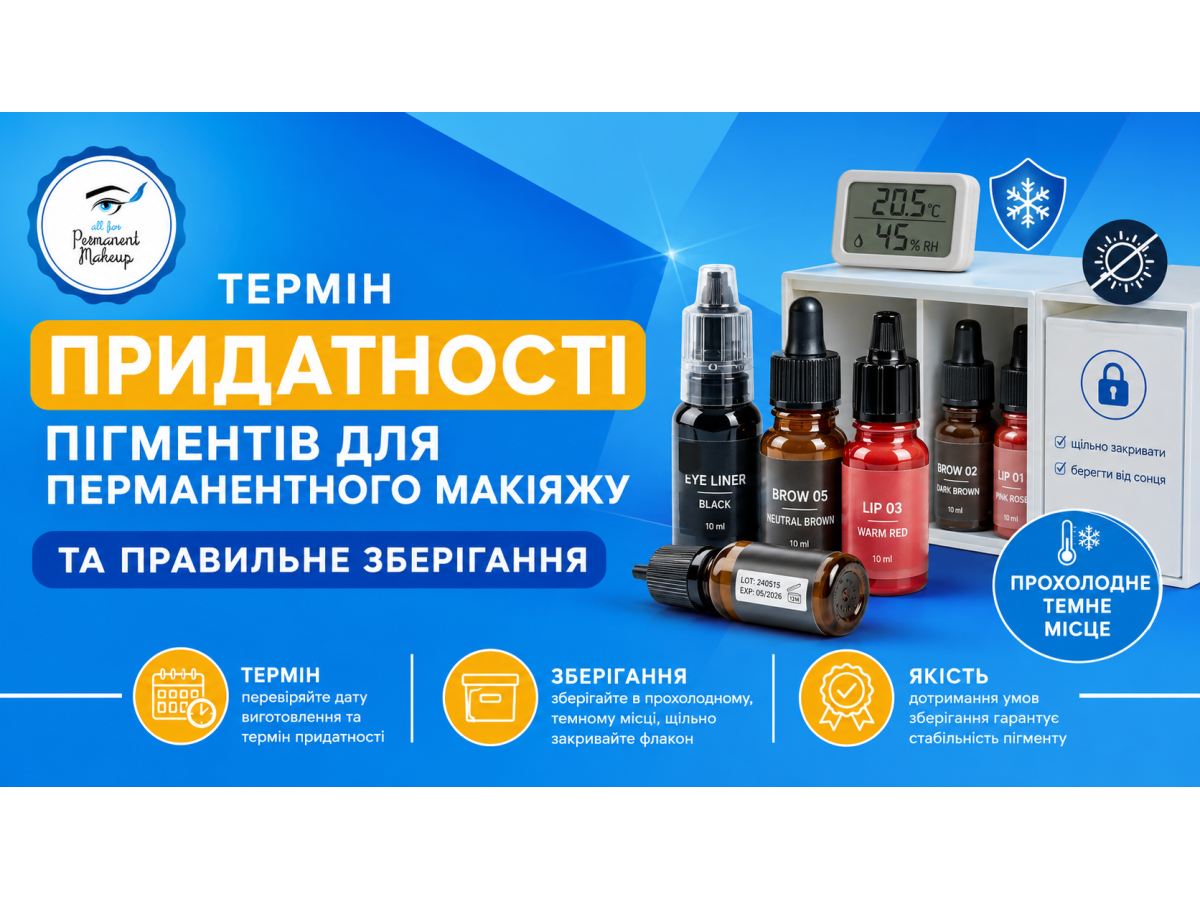
Pigments for permanent makeup are not just “color in a bottle.” They are professional materials that are implanted into the skin, so their shelf life, storage conditions, and hygiene of use should be treated as seriously as the sterility of needles, cartridges, and the workstation.
Even the highest-quality pigment can lose stability if it is stored in direct sunlight, near heating devices, in a humid room, or if the bottle is constantly opened with unclean hands. An expired or improperly stored product can affect not only the healed color, but also the safety of the procedure.
In this article, we will explain the shelf life of permanent makeup pigments, what the date on the bottle means, how long pigment can be used after opening, and how to store materials properly in a studio.
Why pigment shelf life matters
In permanent makeup, the result depends on many factors: the artist’s technique, implantation depth, skin type, aftercare, and pigment quality. But if the pigment is expired or has been stored incorrectly, the result becomes harder to predict.
Over time, the product’s physical properties may change: consistency, uniformity, carrier stability, and particle distribution. Pigment may thicken, dry out, mix less effectively, or deliver unevenly. Sometimes these changes are visible right away, and sometimes the bottle may look normal, but the product can no longer be considered reliable.
Shelf life is not a formality. The manufacturer indicates the period during which the product maintains its stated properties when stored correctly. In professional practice, the artist should follow the labeling of the specific brand, not advice such as “mine stood for two years and was still fine.”
Besides color quality, safety is also important. Tattoo and permanent makeup pigments are materials that come into contact with compromised skin. That is why shade and workability are not the only things that matter. Sterility, bottle cleanliness, absence of contamination, and proper storage conditions are just as important.
Shelf life of unopened pigments
The shelf life of an unopened bottle should always be checked on the label or in the manufacturer’s technical information. It may vary from brand to brand. Many unopened pigments are commonly stored for about 2–3 years under proper conditions, although some manufacturers may specify a different period.
It is important to understand that an unopened bottle is not an “eternal” bottle. Even if the cap has never been opened, the product should not be used after its expiration date. Every product has a stability period, and after it ends, the manufacturer no longer guarantees quality, safety, or predictability of the result.
When purchasing pigment, the artist should check:
- the production date or expiration date;
- the batch number;
- the integrity of the packaging;
- the presence of a protective seal or membrane, if provided;
- the product’s compliance with the requirements of the region where it is used.
If the expiration date is approaching, it is better not to buy the pigment “for later,” even if it has a good discount. The studio may simply not use it in time.
How long pigment can be used after opening
After the bottle is opened, the usable period is usually shorter. The reason is simple: the product begins to come into contact more often with air, the cap, the artist’s hands, the work surface, and the surrounding environment. Even with careful use, the risk of contamination and changes in product properties increases over time.
Many manufacturers and professional recommendations advise using opened pigments within 6–12 months unless the brand states another period. A common practice is to discard the bottle 12 months after opening.
A good habit is to write the opening date on the bottle immediately. This can be done with a marker on the label or with a separate sticker. This way, the artist can see not only the general expiration date, but also the real period of use after the first opening.
For example, if the bottle expires in December 2027, but you opened it in February 2026, you should not rely only on December 2027. If the manufacturer recommends using the product within 12 months after opening, it is better to discard the bottle in February 2027.
What PAO means and why it matters
On some cosmetic and professional products, you may see an open jar symbol with markings such as 6M, 12M, or 24M. This is PAO — Period After Opening. For example, 12M means the product is recommended for use within 12 months after first opening, provided it is stored correctly.
Not all pigments use the same labeling, so it is important to read the instructions from the specific manufacturer. Sometimes the period after opening is listed in the product description, on the box, in the certificate, or in the brand’s official recommendations.
The main rule is simple: if the general expiration date and the period after opening are different, follow the date that comes first.
How to store permanent makeup pigments properly
Proper storage helps maintain pigment properties and reduce the risk of contamination. The basic rules are simple: a cool, dry, dark place, original packaging, a tightly closed cap, and no sudden temperature changes.
The best storage place is a closed cabinet, drawer, or organizer in a clean area of the treatment room. Pigments should not be kept on a windowsill, near a lamp, radiator, sterilizer, sink, or in any area where water may reach them.
Sunlight and heat can speed up changes in the product. Humidity increases the risk of contamination on the packaging and cap. Opening the bottle unnecessarily increases contact with air. That is why pigments should be kept closed and taken out only during preparation for the procedure.
A refrigerator is usually not necessary unless the manufacturer directly recommends this storage method. In fact, refrigerator storage may create condensation during temperature changes if the bottle is constantly taken out and put back. Therefore, the universal option is stable room temperature in a dry, dark place, unless the instructions say otherwise.
Hygiene when working with an opened bottle
Even proper storage will not protect the product if hygiene is violated during work. The most common mistake is touching the pigment cup, skin, gloves, or work surface with the bottle nozzle. The nozzle must stay clean. Pigment should be dispensed carefully without touching other objects with the bottle.
Leftover pigment from the cup must never be returned to the bottle. Even if the pigment looks clean, it has already been in contact with air, the cup, the work area, and potentially microscopic particles.
It is also better not to dilute pigment directly in the original bottle unless the manufacturer specifically allows this. The required amount should be mixed in a separate sterile pigment cup. This keeps the main bottle clean and allows the artist to control only the working portion.
After use, the cap should be closed immediately. The bottle should not remain open on the table throughout the procedure.
Where pigments should not be stored
There are several places that are not suitable for storing pigments.
The first is a windowsill. Even if the palette looks beautiful there, sunlight and heat can damage the product.
The second is an area near a radiator, lamp, or other heat source. Overheating may change the pigment’s consistency and stability.
The third is a bathroom, sink area, or any humid zone. Moisture and splashes increase the risk of packaging contamination.
The fourth is an open shelf near the working area, where bottles may be exposed to dust, aerosol, antiseptic, or particles from surfaces.
The fifth is an artist’s bag without temperature control. If the artist travels for training, a championship, or a procedure, pigments should be transported in a separate closed case protected from heat, cold, and direct sunlight.
When pigment should be discarded
Pigment should be discarded if the expiration date has passed, the allowed period after opening has ended, or there are doubts about its cleanliness. It should also not be used if the consistency has changed, an unusual smell appears, the bottle is damaged, the cap does not close properly, the nozzle is contaminated, or the product has been stored in unsuitable conditions.
It is important to distinguish normal separation from suspicious changes. Many pigments may settle, and they should be shaken thoroughly before work according to the manufacturer’s instructions. But if, after shaking, the product remains lumpy, looks uneven, has dried out, thickened, or behaves unusually, it is better not to take the risk.
The rule is simple: if the artist doubts whether to use it, it is better not to use it. The cost of a bottle cannot be compared with the risk of ruining a result, receiving a client complaint, or creating a safety issue.
How to track pigments in a studio
A professional studio should have a simple tracking system. This is especially important when several artists work in the same space and there are many shades.
It is convenient to keep a table or log with the following information:
- brand and shade name;
- batch number;
- purchase date;
- expiration date;
- opening date;
- discard date;
- usage notes.
Even if the studio is not legally required to keep such records, batch tracking is a good professional habit. If a client has a reaction or a question about the procedure, the artist will be able to identify exactly which product was used.
How to organize storage in the treatment room
It is best to separate pigments by category: eyebrows, lips, eyelids, correctors, and thinners. Within each category, shades can be arranged by tone: light, medium, dark, warm, and cool.
Bottles that are approaching their expiration date should be placed in front. New ones should go behind them. This simple rule helps products be used in the correct order and prevents older shades from being forgotten in the back of a drawer.
Once a month, it is useful to do a revision: check expiration dates, opening dates, bottle condition, cap cleanliness, and whether the necessary shades are available. It does not take much time, but it helps avoid unpleasant situations before a procedure.
Common mistakes artists make
The first mistake is not writing down the opening date. After a few months, the artist no longer remembers exactly when the bottle was opened and starts estimating. For professional work, that is not enough.
The second mistake is storing pigments beautifully rather than correctly. An open shelf with bottles may look impressive in photos, but for the product, a closed cabinet without light and dust is better.
The third mistake is using expired pigment for practice on clients or for “simple” procedures. An expired product does not become safer just because the procedure seems easy.
The fourth mistake is mixing different products without understanding compatibility. Not every thinner is suitable for every pigment. It is better to follow the manufacturer’s recommendations.
The fifth mistake is buying too many shades. A large palette looks professional, but if the artist cannot use the bottles in time after opening, part of the materials will simply have to be discarded.
Conclusion
The shelf life of permanent makeup pigment is an important part of procedure safety and quality. An unopened bottle can only be used until the date specified by the manufacturer. After opening, the usable period usually becomes shorter, and the artist should follow the PAO or the brand’s recommendations.
Proper storage means a dry, dark, cool place, original packaging, a tightly closed cap, and careful work without contaminating the bottle nozzle. Leftover pigment must not be returned to the bottle, materials should not be stored in sunlight, expired products should not be used, and changes in consistency should not be ignored.
A professional artist controls not only shape, color, and technique, but also the entire path of the material: from purchase to disposal. These details create stable results, safe procedures, and client trust.