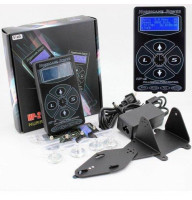
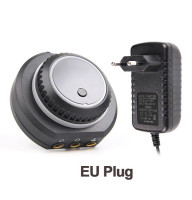
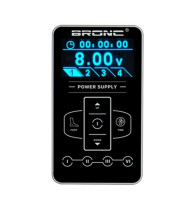
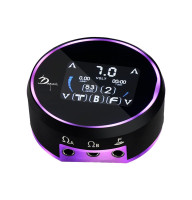
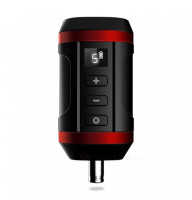
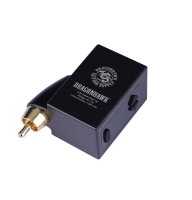
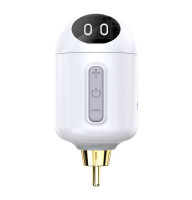
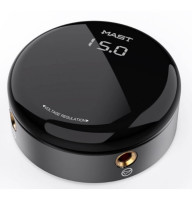
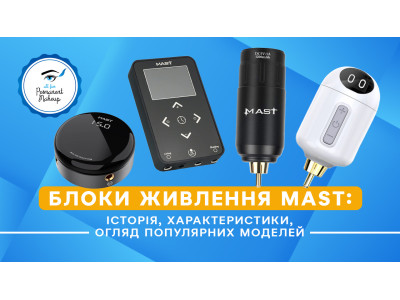
The power supply for a tattoo machine is the most important component of the comfortable and safe work of a tattoo artist, and a factor that directly affects the quality of permanent makeup.
But the variety of models of these devices on the market today can be confusing. How to choose power supplies to improve your skill, comfort and safety?
Power supplies for tattoo machines and their significance
In the tattoo industry, the requirements for the accuracy of strokes and lines, the depth of pigment application, etc. are very high. But these requirements increase many times over when it comes not to artistic tattoos, but to permanent makeup. Here it is necessary to work extremely accurately and masterfully, because the result of the work is literally obvious.
Therefore, artists approach the choice of a tattoo machine, a set of needles and other tools with the utmost care. But we must not forget about the power supply - it provides the energy for the operation of the machine and allows you to precisely regulate the parameters of the needle movement.
The role of power supplies in ensuring stable power supply to a tattoo machine
In an ordinary household electrical network, the average voltage is 220 V. But this is an unstable indicator, which, under the influence of a number of factors, can fluctuate from 90V to 330V. Such surges are unacceptable for a tattoo machine, which must be supplied with a constant voltage. This allows her to make uniform blows with a given power and frequency - otherwise the introduction of pigments into the skin cannot be done accurately and accurately.
In addition, an unstable power supply to the machine will damage it before the first tattoo is completed - the thin circuit of this instrument and high-precision settings will not withstand power surges. The role of the AC-to-DC converter and voltage stabilizer is performed by the power supply. It transforms the alternating value of the network 220 V into constant 5-18 V (the approximate range in which tattoo machines operate), and ensures that the specified voltage is supplied to the tattoo machine. Accordingly, the output power and voltage are also protected from fluctuations, which can change the frequency of needle strikes and negatively affect the quality of permanent makeup.
Technical aspects of power supplies
When choosing a power supply for a tattoo machine, you need to focus on its technical characteristics, which are indicated in the accompanying instructions or data sheet. The main and most significant indicators that directly affect the comfort and quality of the master’s work are the following.
Current conversion type
When choosing a power supply for an induction tattoo machine or a rotary-type device, you need to decide on the method of converting alternating current to direct current. In tattoo salons, pulse or induction models are more often used (converting alternating current to direct current due to magnetic induction). But analog, or transformer, although considered more outdated, still remain on the market. In such units, current from the network is supplied directly to the transformer, from where the power is redirected to the rotor or inductor of the tattoo machine.
Voltage
This indicator is measured in volts (V) and affects the speed at which the tattoo machine needle moves and the force of its blows. Accordingly, the more powerful the machine, the more powerful the power supply should be. A high-performance tattoo machine will require a power supply capable of delivering from 14V to 20V at maximum. Weaker devices simply will not be able to “start” the needle’s oscillation cycle, provide it with sufficient impact force, and introducing pigment into the skin will be very problematic. Most tattoo machines operate in the range from 5 V to 18V, within which you can independently adjust the voltage. It is important to understand that the larger the volt range and the smaller the settings step, the easier it is to adjust the unit to work with different tasks - for a higher or lower frequency of needle immersion into the skin, for a higher or lower intensity of needle strikes, etc.
Current strength
This indicator is measured in amperes (A) and is extremely important for the smooth operation of the machine under high loads. To put it simply, current is the result of the power supply converting the “invisible” voltage into an actual physical quantity. The more powerful the tattoo machine, and the higher the voltage settings when working with it, the higher the current readings should be.
The majority of units on the market are designed to output 1-3 A, and this is quite enough for classic types of permanent makeup. But if you are performing a specific, non-trivial tattoo, then it may make sense to consider purchasing a power supply with a higher amperage.
Setting and display
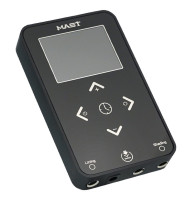
The power supply can be equipped with mechanical or touch voltage regulation. As a rule, in the settings you can set the voltage in steps of 0.1V, but how to do this - by turning the knob or by pressing the corresponding icons on the touch panel - is up to you. Experienced permanent makeup artists can determine the settings just by the sound of the machine running. But for beginners in this field, it is better to give preference to units with a display. It displays the current settings and allows you to change and adjust them without error. The specified operating parameters of the machine can be displayed on the unit in analog or digital form. Which display option to prefer also depends on your habits and preferences. But if you choose an analog device, it is important to keep it in a well-lit place so that the position of the arrow is visible at first glance. This requirement is not relevant for power supplies with a digital display: the built-in backlight is quite enough to instantly read the device’s readings.
Functional
The power supply for a permanent makeup machine should be convenient for the artist, make his work as easy as possible and correspond to the tattoo technique being performed. In the list of models of such devices you can find names with the following functions:
- Memory function. Thanks to this option, the power supply remembers the models of machines that have already been connected to it and the settings of the last few sessions (their number depends on the model of the unit).
- Automatic detection of the type of connected machine. This allows you to immediately “coordinate” the operation of the unit and the machine, without making additional settings.
- Determining the total session time and calculating the cost of the work (after entering the price tag per minute, per square centimeter, etc. into the program).
- Function of switching between different operating modes (outlining, painting). This is the best option when working with universal or hybrid tattoo machines, which provide the ability to perform both types of tattooing.
- The ability to start the machine with or without a pedal. This option will be useful for craftsmen who work in different conditions - at a table or behind a chair in a salon, or on the road.
- A timer that accurately determines both the “pure” duration of the session - without pauses and forced stops - and the total duration.
These and other additional functions may be optional for one master, and literally indispensable for another. Therefore, when choosing a power supply, be guided by your personal needs, experience and specifics of work.
How to choose a power supply?
All of the above information suggests that when choosing a power supply you need to keep in mind only your own working inputs - the specifics of working conditions, the characteristics of the tattoo being performed, etc. But there are several unconditional criteria that must be taken into account in any case:
- The power supply must be 100% compatible with the tattoo machine and the power supply. This applies to both the technical aspects of the machine itself (permissible voltage and current ranges, type of connection, etc.) and the electrical network to which the unit will be connected. So, if you work with clients overseas, you'll need a power supply with a wider volt and hertz range, allowing you to plug it into outlets in countries with different electrical standards.
- High quality device. Professionalism in tattooing is impossible without professional equipment. Therefore, it is better to give preference to power supplies from well-known manufacturers with an impeccable reputation, rather than cheaper “no-name” analogues that can fail directly during a session. In addition, low-grade power supplies significantly increase the risks for the tattoo machine itself, which may be damaged due to voltage fluctuations.
- The power supply must be fully suitable for the tasks for which you are purchasing it. This applies not only to switching modes between liner and shader, but also to other features. So, what may be most convenient for you is a desktop wired power supply or a portable wireless one, a unit with a stationary mount on magnets or devices with rotating mechanisms, etc.
Having decided on the listed criteria, you can begin to select a specific type of power supply.
Types of power supplies: their advantages and disadvantages
The main indicator by which power supplies can be classified is the method of converting alternating current into direct current.
- Pulse (induction) units convert alternating current into direct current using magnetic induction. They are lightweight and compact in size. They have an undeniable advantage: induction units not only provide a constant supply of the required voltage, but also filter the current from input noise. Such interference can negatively affect both the tattooing process (as it destabilizes the needle stroke) and the machine itself, and shorten its service life.
- Analog or transformer. More “bulky” and heavier, and less and less used in professional tattooing. But their advantage lies in high productivity. When using an induction tattoo machine, which has very moderate needs, the same induction energy source is sufficient. But the power supply for a rotary tattoo machine, especially if it is powerful enough, is better to choose from the transformer category, since they are able to quickly and effectively “swing” the striker and make the needle move with a given frequency and force. As an option, you can choose an induction unit, but with the mandatory Jump Start function. It is designed to turn on the unit at increased voltage, without a gradual and step-by-step increase in voltage. Thanks to this, the powerful rotor of the tattoo machine comes into working condition immediately after turning it on.
These devices are also classified according to their stationarity and portability. A wireless power supply for tattoo machines used to be the preferred choice of tattoo artists working on-site. But today such devices are becoming increasingly popular among tattoo specialists who work exclusively in salons. The advantage of such units is better stabilization of induction and rotary motors, and, accordingly, the ability to control the vibration of the tattoo pen.
Wireless units can be charged either from a 220V network or from a car cigarette lighter or power bank. The main disadvantage of such devices is that the longer battery life it is designed for, the higher its weight, which can be inconvenient in some cases.
Safety when using power supplies
The power supply for a tattoo machine, just like any other electrical device, requires attention to safety precautions. And taking into account the specifics of the device’s operation, safety can be divided into two categories: technical and sanitary.
Recommendations for sanitary and hygienic safety of the power supply
Before starting each individual session, it is necessary to shield the power supply using special barrier protection. It can be in the form of a self-adhesive roll of film, in the form of a pocket, or, in the case of wires, in the form of a film sleeve.
If the power supply is touch-controlled, it is important to make sure that the protective screen does not interfere with the settings, and when you press any icon through the film, the unit responds adequately to the command.
Also, the power supply must be allowed to be periodically treated with disinfectants. This feature is provided by default for well-known brands: moisture-resistant materials are used for the case, the perimeter of the rotating mechanisms is protected by sealed gaskets, and markings are applied either with ultra-durable paint or on the “underside” of the touch screen.
Measures to prevent overheating, short circuit and other technical problems
If we talk about high-quality power supplies, their failure is most often associated with mechanical damage or improper operation.
Therefore, follow these recommendations:
- Place the power supply on a reliable surface that is firmly attached to the floor, wall, etc. - this will protect the device from accidental drops.
- Before starting work, make sure that neither the power supply nor the cables interfere with your movements, including moving to a different position relative to the client.
- To connect the unit to an outlet and connect to the machine, use only the cables that come with the unit or purchased separately, but are 100% compatible with it.
- Do not connect the unit to faulty, damaged or simply “questionable” sockets.
It is also useful to know that if a tattoo machine or pen noticeably overheats, the cause is often the power supply, namely its inadequacy. If your main tool is heating up, it may mean that the power supply is not producing enough voltage for the machine, or that it is not designed to maintain the required voltage and/or amperage for long periods of time. In such cases, it is necessary to replace the device with another one that matches both the machine model and the workload.
It would also be useful to purchase a power supply with pre-installed protection against overloads and overheating - such devices automatically turn off in the event of unacceptable failures/damages in the electrical network or in the event of breakdowns in the machine itself, and thus provide protection not only from unreasonable expenses, but also from unintentional errors during execution tattoo