
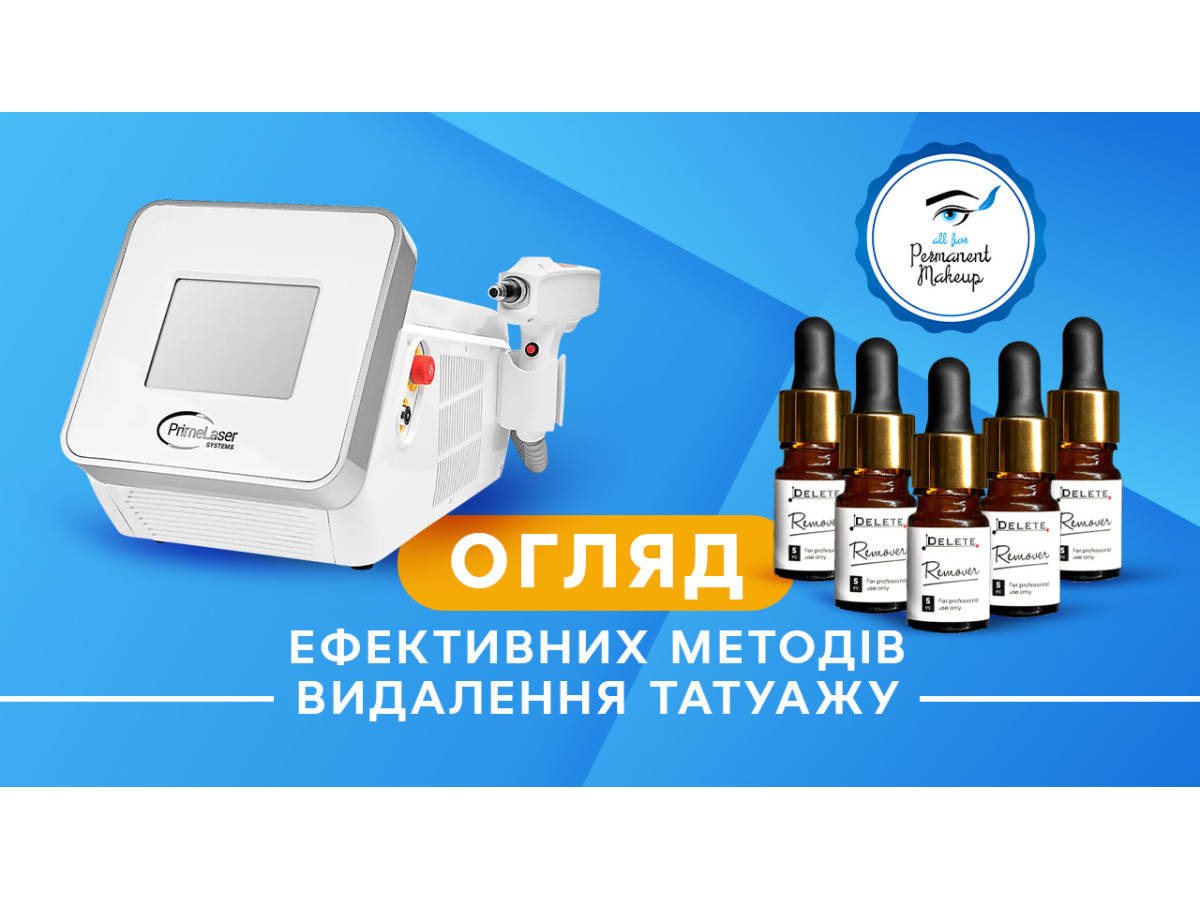
The main advantage of tattooing is its permanence and resistance to any kind of influence - burnout, washout, etc. But this same quality sometimes turns into a disadvantage. Many reasons may make a client want to remove unsatisfactory, unfashionable or simply boring permanent makeup.
Relatively recently, all that the beauty industry could offer was a rather traumatic approach - dermabrasion and electrocoagulation, which did not promise tattoo removal, but practically guaranteed subsequent skin problems, including scarring. Fortunately, science does not stand still, and today artists can use laser technologies, correctors or removers to remove tattoos. In our article we will introduce you to these methods, and consider the advantages and disadvantages of each of them.
Reasons why people decide to remove tattoos
The range of reasons why there is a desire to remove tattoos is huge. This may be the inexperience or negligence of a specialist who did not take into account the characteristics of a particular pigment, used unprofessional paints, or was not aware of the “behavior” of pigments on different skin types. Most often people apply for permanent makeup removal for the following reasons:
- a change in beauty trends, when the already made width/shape of the eyebrows, lip contour, arrows or the technique in which the tattoo was done is considered outdated;
- a boring tattoo that the client “wore” for many years in a row;
- a shift in the shade of the pigment towards blue, which may occur due to the excessive depth of its introduction;
- previous skin diseases, excessive use of chemical peels, etc., after which the pigment “floats” and the lines lose clarity;
- initially incorrectly done tattooing, without taking into account the natural asymmetry of facial features, the characteristics of the client’s skin, etc.;
- the desire to change the thickness, shape, color of the lines of the previous tattoo, the pigments of which have not yet undergone complete biodegradation, and their covering during the next procedure is impossible.
Each person has their own reasons for tattoo removal. But it is important for the master to convey to the client that if he wants to undergo the “reverse” procedure, he must choose methods and means designed specifically for this. And explain that any amateur activity can turn into a complete disaster - both aesthetic and general medical in nature.
The importance of safe and effective removal methods
Professional methods for removing tattoos themselves can minimize the likelihood of developing undesirable consequences. And in the hands of a professional, such drugs and equipment equate the risks to almost zero.
This cannot be said about other methods and means. Many of them are widely and successfully used in cosmetology, but are not intended for tattoo removal. These are chemical peels, biorevitalization and many other methods that are designed to enhance metabolic processes in the skin and thus supposedly accelerate the removal of pigments.
Another category of techniques can even be called barbaric - these are microinjections of alcohol, milk, compresses from celandine extract, etc. Such attempts to remove tattoos are absolutely ineffective in relation to pigments, but are almost guaranteed to leave behind inflammation (at best) or deep scars.
Moreover, after such procedures, even professional equipment and tools may be powerless, since:
- pigments undergo chemical transformation, after which they become difficult to access by laser or remover;
- local metabolic processes in the skin are disrupted, which impairs the natural removal of pigments;
- The condition of the skin after incorrect methods no longer allows tattoo removal with a laser or remover.
As a result of an unprofessional approach, boring, unfashionable or low-quality tattooing remains in place, but in addition to it, chronic peeling, inflammation, changes in skin structure, atrophic, hypertrophic or keloid scars appear.
Tattoo removal methods and their mechanism of action
In the modern beauty industry, three methods of tattoo removal are used, which have proven to be effective and have a high safety profile.
Laser tattoo removal
Neodymium laser is mainly used to remove permanent makeup. Its peculiarity is the ability to generate ultrashort light pulses that effectively destroy pigment, but do not have time to heat cells or cellular fluid.
Essentially, the pigment acts as a “target” for the laser beam, which penetrates directly into the paint particles and heats them until they are completely destroyed. Over time, pigments that have lost their original structure are removed from the skin along with the lymph flow and other metabolic processes in the skin. To completely remove a tattoo, several procedures may be necessary, depending on the depth and density of the pigments. And the final result will appear after 3-8 weeks - this depends, among other things, on the individual metabolic rate and age of the client, the variety and quality of pigments, etc.
Removers for tattoo removal
A remover for removing tattoos from lips, eyebrows, and eyelids is a solution or suspension that, when in contact with pigments, destroys the bonds in the paint molecule and/or its connection with skin cells. After the procedure, the pigments lose their coloring properties and are naturally absorbed by tissues, removed with lymph flow, or “washed out” to the surface of the skin.
Today, removers can be called the safest and most effective means for removing permanent makeup. Of course, this is important for choosing the right product and strictly following all recommendations for its use.
Covering up tattoo
With this method, neutralizing or antagonist pigments are used, which are driven into the skin and thus make the originally applied pigments practically invisible.
Although this method is not technically called tattoo removal, it is often used to partially cover up the underlying color, shape, line thickness, etc. to facilitate subsequent tattoo correction.
Safety of use and possible side effects
Professional tattoo removal products are safe by default, as they are developed specifically for this purpose and undergo extensive testing and research. But the safety profile of removers can be significantly reduced under the following circumstances:
- tattoo that requires removal was made with unprofessional pigments or paints of dubious origin/quality;
- pigments are introduced to too great a depth;
- before contacting the artist for tattoo removal, the client had already made independent attempts to get rid of pigments;
- The client initially has problematic skin in the area of tattoo removal - inflamed, with an active infectious process, prone to the formation of scars, etc.
If even one of the listed factors is present, a particularly careful selection of a remover is required, which in a particular situation will be most effective and at the same time safe.
In some cases, preliminary treatment by a dermatologist may be required before the skin is ready to remove permanent makeup.
But even if there are no problems at the consultation stage, during the process of tattoo removal you may encounter an individual skin reaction to the remover. As a rule, this is redness, inflammation, peeling, swelling, burning in the area where the product is applied. Such side effects do not require special treatment and go away on their own as the skin recovers - provided that the client follows all the recommendations of the specialist.
Comparison of tattoo removal methods
There is no point in comparing the listed methods, since a method that is effective and safe in one case may be ineffective or contraindicated in another. The availability of the method also plays a certain role - not every salon offers a laser removal service, and not every client can afford it. Therefore, we will consider the advantages and disadvantages of each method in its “pure form” - from the point of view of their effectiveness, safety and convenience.
Laser method
An undeniable advantage of laser removal is the ability of the laser to penetrate to any depth of the skin. This makes it indispensable for removing permanent makeup with excessively deep pigments, where chemical compounds are unable to penetrate or where it is simply undesirable to introduce them due to the risk of side effects.
But if the base or auxiliary pigment is from a yellow or green palette, it will take several sessions to destroy them. And in a situation with the “white kajal” technique, the laser will be completely useless, since it “does not see” the white pigment with which the highlights are created.
In addition, there are many restrictions on the use of lasers. Thus, removing tattoos on tanned skin is associated with the risk of scar formation, since the laser can “perceive” accumulations of melanin (skin pigment) as a target. Also, this method is strictly contraindicated for a number of diseases and conditions, not only dermatological, but also somatic.
Removers
This is an almost universal method - among the modern variety of products, you can choose a remover to suit any characteristics of the skin or tattoo. Moreover, acids, alkalis and salts act with equal effectiveness on pigments of any color, so you can even cope with a beige palette or white dye.
With the right choice of product, you can avoid almost any risk. But you should convey to the client the importance of proper skin care after the procedure, and inform him in detail about all the details of such care. This is of great importance, since in most cases complications arise precisely at the recovery stage, due to incorrect actions of the client.
Overlap
Overcoating is used to a limited extent and mainly as an auxiliary method to neutralize small areas of pigment. This is due to the fact that it is quite difficult to choose a shade that perfectly matches your skin tone. This is further complicated by the seasonality of skin tone: in the warm season, when the skin naturally darkens, the pigment does not change its tone and becomes clearly visible. Therefore, in the most “catastrophic” situations, when the tattoo is made asymmetrically, has become very blurred or its color has changed, it is recommended to use a laser or remover. And overlapping is optimal as a temporary option or for minor correction of shape and color.
Which method to choose depending on the type of tattoo and individual characteristics
Before making the final choice of one method or another, the following circumstances should be taken into account:
- The client has contraindications to any method.
- Depth of pigments. If they are driven very deeply (this can be determined by the transformation of black, gray, graphite color into blue), it is more rational to use laser removal.
- Pigment type and density. For very dark and densely filled areas, you can use a combined approach, in which the bulk of the dyes are removed with a laser, and at the final stage a remover is applied.
- Procedure area. If it is necessary to remove interlash tattoo, only laser technology is used, since acid tattoo remover, alkaline or saline solution are unsafe for the eyes.
- Features of the client's skin. If the skin is prone to scarring, the choice is limited to neodymium laser and acid-salt removers. All other techniques are quite traumatic for sensitive skin and can provoke the growth of connective tissue and the formation of scars. Removers are recommended for dark or very tanned skin, as the laser will be ineffective and unsafe.
We hope our article helped answer basic questions regarding tattoo removal using modern means. With the right choice of method, the specialist’s professional approach to the procedure and the client’s responsible attitude towards the recovery period, any “permanent defects” can be eliminated without risks to health and appearance.