
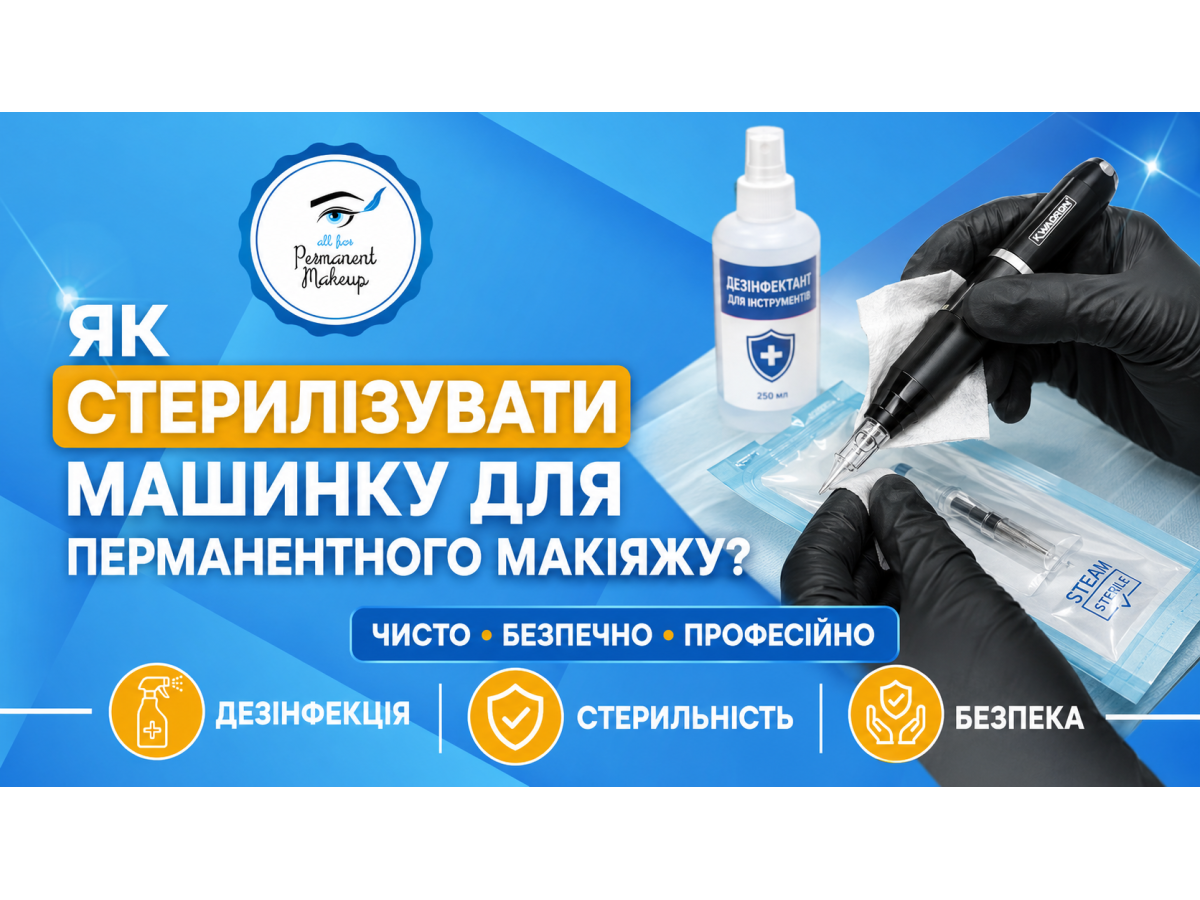
This distinction is essential. A PMU machine is an electrical device with a motor, housing, connectors, and internal parts. It cannot simply be placed in an autoclave, soaked in solution, or rinsed under water unless the manufacturer clearly allows that processing method. Incorrect “sterilization” can damage the device and still fail to make it safe.
At the same time, the machine works close to broken skin, pigment, lymph, blood, and the artist’s gloves. That is why the artist’s task is not to “wipe the handle somehow,” but to build a clear protocol: barrier protection before the procedure, careful work during the procedure, proper barrier removal, cleaning, disinfection, and storage after each client.
Sterilization, disinfection, and cleaning: what is the difference?
Artists often use the word “sterilization” for any kind of instrument processing, but from the perspective of infection control, these are different processes.
Cleaning means removing visible contamination: pigment, dust, biological traces, and product residue. Without cleaning, disinfection works less effectively because contamination can interfere with contact between the disinfectant and the surface.
Disinfection is the treatment of a surface with a special product that reduces microorganisms to a safe level. For the machine body, cords, power supply, and work surfaces, disinfection is usually the main method used.
Sterilization means destroying all forms of microorganisms, including spores. It is required for reusable instruments that come into contact with broken skin or sterile tissues.
In permanent makeup, sterile disposable cartridges are not reprocessed after the procedure. They are disposed of as sharps waste. The machine itself is protected with a barrier and disinfected externally.
Can a PMU machine be sterilized in an autoclave?
In most cases, no — the entire machine cannot be sterilized in an autoclave. An autoclave uses high temperature, steam, and pressure. For an electronic device, this may damage the motor, battery, wiring, housing, connectors, and internal mechanisms.
Only parts for which the manufacturer clearly states this option can be sterilized. For example, some removable metal grips, holders, or adapters may be autoclavable. Even then, the artist must follow the manufacturer’s instructions: how to disassemble, how to clean, how to package, which cycle to use, and how to store the item after sterilization.
If a part cannot be sterilized, it should be protected with a disposable barrier and treated with an appropriate disinfectant.
Why barrier protection is necessary
Barrier protection is the first level of safety for the machine. It does not replace disinfection, but it reduces the risk of contamination of the housing, buttons, cord, and connectors during the procedure.
For the machine, artists use:
- a disposable machine sleeve;
- a barrier for the grip or holder;
- protection for the cord or clip cord;
- film for the power supply, button, lamp, treatment bed, and work surfaces;
- disposable pigment cups.
The barrier should cover the areas the artist touches during work with contaminated gloves. If the machine is wireless, the body should be covered in a way that does not block ventilation areas, if the design includes them.
After the procedure, the barrier should be removed carefully by turning the contaminated side inward. The film should not be pulled in a way that allows pigment drops or biological material to reach the clean machine surface. The barrier is discarded immediately, and then cleaning and disinfection are performed.
How to prepare the machine before the procedure
Before the procedure, the machine should be clean, functional, and visually free from pigment or contamination. The artist washes and disinfects their hands, puts on gloves, and prepares the workstation.
First, the work surface should be disinfected, and disposable materials should be laid out: a sterile cartridge, pigment cups, pigment, wipes, and barriers. Surfaces and objects that are difficult to process properly during work should be covered in advance with disposable barrier film.
Then the machine is covered with a protective sleeve. If a cord is used, it is also placed inside a protective sleeve. After that, a sterile disposable cartridge is installed. It is important not to touch the sterile part of the cartridge with contaminated gloves and not to place it on an unprotected surface.
If the artist touches a phone, door handle, hair, clothing, or another unprotected surface during preparation, the gloves should be changed. Gloves do not make hands “sterile forever”; they protect only until the moment they become contaminated.
What to do during the procedure
During the procedure, the machine should remain inside the barrier. If the barrier tears, slips, or contaminated liquid gets underneath it, the work should be stopped, the contaminated material should be removed, the surface should be processed according to protocol, and a new barrier should be applied.
Clean objects should not be touched with contaminated gloves. If pigment needs to be added, settings adjusted, a phone used for photos, or a cabinet opened, it is better to plan clean and dirty zones in advance.
The machine should also not be placed on an unprotected surface. A disposable underpad, a tray with a barrier, or a designated work area that will be disinfected afterward should be used.
How to process the machine after a client
After the procedure, the cartridge is first removed and disposed of in a sharps container. A cartridge must not be rinsed, saved “for later,” reused, or thrown into a regular trash bin.
Next, the barrier is carefully removed from the machine and cord. This should be done so that the contaminated outer side of the film does not touch the clean machine housing. After removing the barrier, the artist changes gloves and proceeds to processing.
The machine housing is wiped with a disposable wipe to remove visible contamination, if present. Then a disinfectant compatible with the housing material and recommended by the manufacturer is used.
It is usually safer to apply the disinfectant to a wipe rather than spraying it directly onto the machine, because liquid may get into connectors, buttons, the motor, or the battery compartment.
The disinfectant should remain on the surface for the amount of time stated in the instructions. This is called contact time. If the product is supposed to work for 5 minutes but the artist wipes it off after 20 seconds, full disinfection may not occur.
What should not be used to process the machine
The machine must not be soaked in disinfectant solution. It must not be rinsed under running water. Liquid must not be poured into openings, connectors, buttons, or the motor area. The machine must not be placed in an ultrasonic cleaner unless the manufacturer specifically allows it.
A UV box should also not be considered full sterilization. UV treatment may be an additional method for some surfaces, but it does not replace cleaning, disinfection, or sterilization where they are required.
Special care should also be taken with aggressive chemical agents. A solution that is too strong may damage the housing, erase markings, destroy the coating, or damage rubber elements. The choice of product should always consider two things: infection control and compatibility with the machine material.
How to process a removable grip
If the machine has a removable reusable grip, the procedure depends on the manufacturer’s instructions. If the grip is autoclavable, it is first cleaned of visible contamination, then, if necessary, processed in an ultrasonic cleaner, rinsed, dried, packed in a sterilization pouch, and sterilized in an autoclave using the recommended cycle.
After sterilization, the pouch must remain closed until the next use. If the package becomes wet, torn, or opened, sterility can no longer be considered maintained.
If the grip is not intended for autoclaving, it should not be sterilized “at your own risk.” In this case, disposable protection, disinfection, and strict adherence to the brand’s instructions are required.
Common mistakes artists make
The first mistake is thinking that a barrier replaces disinfection. A barrier reduces the risk of contamination, but the machine still needs to be processed after each client.
The second mistake is wiping the machine only with alcohol. Alcohol can evaporate quickly and may not always provide the required spectrum of action or contact time. It is better to use a professional surface disinfectant that is compatible with the equipment.
The third mistake is spraying disinfectant directly onto the machine. Liquid may get inside the housing and damage the electronics. It is safer to work with a wipe moistened with the product.
The fourth mistake is not following the contact time. Disinfection works only when the product remains on the surface long enough.
The fifth mistake is not changing gloves after removing barriers. The outer part of the barrier is considered contaminated, so after removing it, it is better to continue processing with new gloves.
The sixth mistake is reusing the same sleeve or protection. All barrier materials must be disposable.
Mini protocol for processing the machine
Before the procedure
- Disinfect the workstation.
- Prepare disposable materials.
- Put on clean gloves.
- Cover the machine, cord, and work zones with barriers.
- Install a sterile disposable cartridge.
After the procedure
- Remove and dispose of the cartridge in a sharps container.
- Carefully remove the barrier without contaminating the housing.
- Change gloves.
- Remove visible contamination with a disposable wipe.
- Disinfect the machine housing and cord with a suitable product.
- Observe the contact time stated in the instructions.
- Allow the surface to dry.
- Place the machine in a clean storage area.
If there are removable sterilizable parts, they should be processed separately according to the manufacturer’s instructions.
How to store the machine after processing
After processing, the machine should be stored in a clean, dry place: a closed box, drawer, or case. It should not be left on an open table, near used materials, a sink, pigments, or a waste container.
Cables, batteries, and power supplies should also be kept clean. If the artist works on location, the machine should be transported in a separate clean case, not together with used materials, pigments, and consumables.
Conclusion
A permanent makeup machine is usually not sterilized as a whole. It is protected with disposable barriers, cleaned, and disinfected after every client. Only removable parts for which the manufacturer clearly allows autoclaving or another sterilization method should be sterilized.
The main safety rule is not to improvise. The machine should not be soaked, placed in an autoclave, flooded with disinfectant, or treated with aggressive chemicals without instructions. A proper protocol is built on three things: barrier protection, careful disinfection, and following the manufacturer’s recommendations.
A professional artist is responsible not only for beautiful brows, lips, or eyeliner. They are responsible for instrument cleanliness, client safety, and trust in their work. That is why machine processing is not a formality, but an essential part of every procedure.