
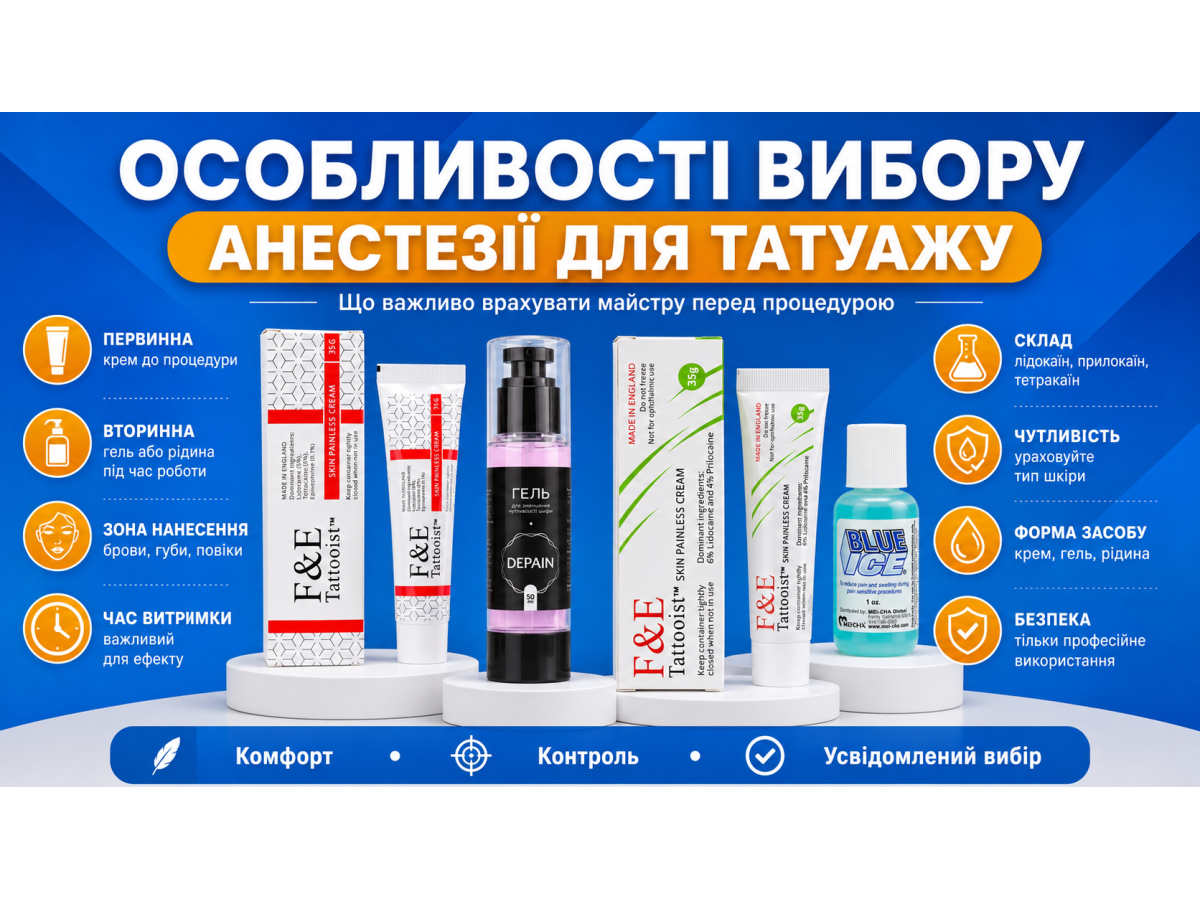
An incorrectly chosen or incorrectly used product may not only numb poorly, but also complicate the procedure: it can cause excessive swelling, change the skin’s reaction, increase fluid release, or create a risk of an unwanted reaction.
That is why anesthetic for PMU should not be chosen by the principle “everyone praises this one,” “this cream is the strongest,” or “it works well for my colleague.” The artist needs to understand which area the product is intended for, what type of skin it can be applied to, which active ingredients it contains, whether it is suitable for primary or secondary anesthetic, and whether it is allowed for sale and use in a specific country.
It is especially important to remember: anesthetic is a product that affects skin sensitivity. It requires careful handling, checking the instructions, and collecting basic information about the client before the procedure.
Why anesthetic choice matters
In PMU, the artist works with delicate areas: eyebrows, lips, and eyelids. Each area has its own sensitivity, skin density, vascularity, and reaction to trauma. What works comfortably on brows may be too active for lips or unsafe for eyelids.
A properly chosen anesthetic helps reduce discomfort, lower the client’s tension, and allow the artist to work more calmly. But it should not mask rough technique.
If the artist works too deeply, repeatedly passes over the same area, or poorly controls skin stretching, even a high-quality anesthetic will not make the procedure correct.
Comfort in PMU consists of several factors: technique, pigment implantation depth, cartridge quality, skin condition, procedure duration, the client’s psychological preparation, and only then anesthetic.
Primary and secondary anesthetic
In the professional field, primary and secondary anesthetic are often separated.
Primary anesthetic is applied before the procedure, usually on intact skin. Its purpose is to reduce the first unpleasant sensations so the client can tolerate the beginning of the work more easily. These products are often creams or gels.
Secondary anesthetic is used during the procedure, when the skin is partially open. It may act faster, but it requires special caution because active substances may absorb more intensely through broken skin.
Not every product is suitable for both stages. If a product is intended only for intact skin, it should not be used during the procedure “to enhance the effect.” And conversely, secondary products are not always appropriate as primary anesthetic.
The main rule is to read the instructions from the specific manufacturer, rather than relying only on advice from artist chats.
Composition: what to pay attention to
Numbing products may contain lidocaine, benzocaine, tetracaine, prilocaine, epinephrine, or other components. They can differ in mechanism of action, concentration, speed of effect, duration, and risk of reactions.
Some topical numbing products may be risky if they contain high concentrations of active ingredients, are applied to large areas, irritated or damaged skin, left on for too long, or covered with film.
For an artist, this means it is important to check not only the product name, but also its composition, concentration of active ingredients, official intended use, and method of application.
“Strong anesthetic” does not always mean “better anesthetic.” Sometimes an overly active product can create more problems than benefits.
Choosing anesthetic for eyebrows
Eyebrows are usually considered a less painful area compared to lips or eyelids. The skin is denser here, and the procedure is often tolerated quite comfortably, especially if the artist works in a soft shading technique.
For eyebrows, a delicate primary anesthetic or minimal numbing may often be enough. But everything depends on the client. People with a low pain threshold, high anxiety, or sensitive skin may feel noticeable discomfort even during brow procedures.
When choosing a product for eyebrows, it is important that it does not provoke excessive swelling and does not make the skin too “rubbery” or difficult to work with.
If after applying anesthetic the skin becomes dense, slippery, or very red, it may be harder for the artist to control depth and even pigment implantation.
Choosing anesthetic for lips
Lips are one of the most sensitive areas in PMU. There are many nerve endings, active vascularity, thinner tissue structure, and a more frequent swelling response. That is why anesthetic for lips should be chosen especially carefully.
Clients often expect lips to be done completely painlessly, but this is not always realistic. Even with good anesthetic, sensations of pressure, vibration, warmth, or mild burning may remain.
For lips, it is important to choose a product that is suitable for this specific area and does not cause excessive blanching, dryness, or strong swelling.
If tissues change significantly under the effect of anesthetic, it becomes harder for the artist to assess the natural lip color, symmetry, and even pigment implantation.
Before a lip procedure, it is also important to ask whether the client is prone to herpes, cracks, dryness, frequent inflammation, or allergic reactions. In such cases, the artist should act especially carefully and recommend a doctor’s consultation if needed.
Choosing anesthetic for eyelids
The eyelid is the most delicate area. Here, not only comfort matters, but also safety. The product must not get into the eyes, irritate the mucosa, provoke strong swelling, or complicate the artist’s work.
For eyelids, any anesthetic should not be used simply because it works well on brows or lips. It is necessary to check whether the manufacturer allows use in this area, how to avoid contact with the eyes, and what contraindications exist.
If the client has eye diseases, increased sensitivity, allergic reactions, a strong tendency to swelling, or has recently undergone ophthalmological procedures, the artist should not ignore these factors.
In complicated cases, it is better to postpone the procedure or ask the client to consult a doctor beforehand.
Why you should not chase the “strongest” anesthetic
Anesthetic advertising often focuses on strength: “maximum numbing,” “complete absence of pain,” or “effect for several hours.” But for the artist, what matters more is not how aggressively the product works, but how predictable it is.
An anesthetic that is too strong or incorrectly used may:
- change skin color and reaction;
- increase swelling;
- affect fluid release;
- complicate pigment implantation;
- create a risk of irritation;
- cause an unwanted reaction in a sensitive client.
A professional approach is not “take the strongest one,” but to choose a product that matches the area, technique, skin condition, and instructions.
Documents and product origin
Anesthetic should not be bought from private sellers, without packaging, without composition, without an expiration date, or with a suspicious label. This is not just a cosmetic accessory, but a product that contacts the skin during an invasive procedure.
Before purchasing, the artist should check:
- brand and manufacturer name;
- composition and active ingredients;
- component concentration;
- expiration date;
- batch number;
- instructions for use;
- storage conditions;
- supplier documents;
- legality of sale in the country of work;
- intended use for a specific area or skin type.
If the supplier cannot explain the origin of the product or provide basic information, it is better not to take the risk.
Contraindications and questions for the client
Before the procedure, it is important for the artist to collect a brief client history. This is not medical diagnosis, but a basic questionnaire helps avoid obvious risks.
The client should be asked about:
- allergies to numbing products;
- reactions to lidocaine, benzocaine, or other local anesthetics;
- pregnancy or breastfeeding;
- chronic diseases;
- medication use;
- cardiovascular problems;
- epilepsy;
- tendency to strong swelling;
- dermatitis, rashes, cracks, or inflammation in the procedure area.
If there are doubts about safety, the artist should not take unlimited responsibility. It is better to recommend a doctor’s consultation and postpone the procedure.
How to understand that an anesthetic is not suitable
Even a high-quality product may not suit a specific person. During the procedure, the artist should observe the skin reaction and the client’s general condition.
Warning signs may include strong burning, sudden redness, rash, pronounced swelling, dizziness, weakness, rapid heartbeat, shortness of breath, or an unusual client reaction.
In such situations, work should be stopped and the safety protocol should be followed.
The procedure should not be continued just because “there is only a little left to finish.” Client safety is more important than completing the work in one session.
Common mistakes artists make
The first mistake is choosing anesthetic only by popularity. Reviews from other artists can be useful, but they do not replace instructions, composition, and document checks.
The second mistake is using one product for all areas. Brows, lips, and eyelids require different approaches.
The third mistake is applying more product than necessary. A larger amount does not guarantee a better effect, but it may increase risks.
The fourth mistake is leaving anesthetic on longer than the manufacturer recommends. This may change the skin condition and increase absorption of active substances.
The fifth mistake is not asking the client about allergies and medical details.
The sixth mistake is promising complete painlessness. It is better to speak honestly about maximum comfort and individual sensations.
Checklist for choosing anesthetic for PMU
Before adding a new product to work, the artist should answer several questions:
- Which area is this product intended for?
- Is it primary or secondary anesthetic?
- Can it be applied to open skin?
- What active ingredients are in the composition?
- What is the concentration of the components?
- Are there manufacturer’s instructions?
- Are the expiration date and batch number clear?
- Was the product purchased from a reliable supplier?
- Is the product allowed in the country where the artist works?
- Does the client have contraindications or risks?
If at least several questions cannot be answered, the product should not be used on clients.
Conclusion
The key to choosing anesthetic for PMU is balancing comfort and safety. A good product should not simply “numb strongly,” but should suit the specific area, technique, skin condition, and artist’s protocol.
For eyebrows, delicacy and absence of unnecessary skin changes are important. For lips, control of sensitivity, swelling, and tissue reaction matters. For eyelids, maximum caution and strict adherence to instructions are essential.
A professional artist does not choose anesthetic randomly. They check composition, documents, origin, expiration date, intended use, and possible client risks.
This approach helps make the procedure not only more comfortable, but also safer.