An experienced master of permanent makeup as well as the artist can see the invisible to others - perspective, potential of his drawing. This allows you to evaluate the result of the work and «try» a new shape of the eyebrows, the bend of the arrows or the color of the lips on the client’s face before the tattoo.
But talent and special vision are not enough - in the art of tattooing, boring mathematics with its accuracy, symmetry and calculations are of great importance. This helps sketches made by individual markings: they are really indispensable for creating a well-adjusted and harmonious shape, and correcting the asymmetry of facial features.
Today we will discuss tools for lip sketches and ways to make marking perfect.
Tools and materials for lip sketching
When creating the outline of the future sketch you will need one of the following tools:
- surgical marker;
- beauty pencil.
- marking paste;
- gel pen.
It is important that the color of the pencil or paste contrast with the color of the skin: you will see the borders of the sketch during work, and the client will be able to estimate the shape of the lips in advance.
It is also necessary to choose a suitable texture of the pencil: it should be soft enough not to stretch the skin during the drawing of the contours, but at the same time - resistant enough not to blur on the skin.
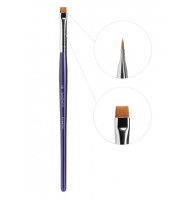
If you plan to use contour paste to mark, you will need a flat brush with a straight cut and/or thread to beat the main directions and points.
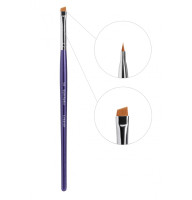
Also make sure that you have hand brushes for lip sketching - already mentioned flat with a smooth edge, flat with a rounded cut - to adjust the contours and round fluffy - for dressing.
Basics of creating a sketch for lip tattoo
Several basic rules will help you to prepare for the sketch and make it as useful as possible.
- The design is always based on natural reference points. These are the coasters - the reference points of the thumbnail length, the filter columns - for vertical guide markings and the cupid arch - for bending and assessing symmetry.
- The way you choose to create a sketch should first of all be convenient for you. So feel free to combine different tools and materials if it helps to ensure high accuracy of sketch, and the client - to get the desired result.
- Demonstration of the sketch to the client is the most important point and it is important to make the drawing as realistic as possible. Therefore, you may need to paint over the entire sketch area. Use matt shades - gloss, visually increasing volume, can mislead the client, which will lead to a wrong assessment of the pattern and, as a result, to an unsatisfactory result. Therefore, tools such as a gel red pen for sketching other means with «lacquer» luster are suitable for creating contours and markings, but not for painting.
- For weaving and painting it is recommended to use brushes for marking special paste - it is resistant to washing, does not roll and does not blur during work. ● After the sketch is drawn and approved by the client, be sure to powder it. This fixes the pattern and prevents it from being erased during permanent makeup application.
- Check the finished sketch for symmetry - both the actual drawing and its symmetry relative to other features of the face. The easiest way to do this is to use a video camera phone: evaluate the sketch by looking at it through it.
Taking these recommendations into account, you can begin to create a sketch.
Lip sketching
Every permanent makeup artist has his own preferences and skills, which he uses to create a sketch. And for those who have just begun to gain experience in the art of tattooing, you will need a classic scheme and sequence:
- Marking. On the upper contour of the upper lip, place marks in the points of the filter columns (points A) and mark the center between them - the lowest point in the cupid arch (point B). Use a flat brush with a flat edge.
- From both points A, move the vertical - steeply down, and place the marks at their intersection with the lower contour of the lower lip (point B).
- Connect points A and point B, forming the bend of cupid arch.
- Draw the contours from the commissaries to points A.
- Connect the two points B on the lower lip, then draw lines from these points to the comissures.
- With a flat brush with a rounded edge, clean the contours by adjusting the outline outline.
- With the same brush blend the paste outward, displacing it beyond the contours.
- If necessary, paint the entire sketch area using diluted tattoo dye or other pigmented agents and ask the client to evaluate the result.
- In the end, fix the picture, for this you will need a powder to fix the sketch - special for tattoo, or any transparent, resistant to showering.
Sketch ready, ready to go!